
Running payroll is rarely straightforward. In India, it becomes significantly more complex when a company operates across multiple states. Different labor laws, tax rules, compliance timelines, and reporting formats make multi-state payroll management a high-risk area for HR and finance teams.
For growing companies, especially those hiring remote employees or expanding into new regions, payroll errors don’t just affect finances. They impact employee trust, invite regulatory scrutiny, and slow down scale.
This article breaks down the key challenges of managing multi-state payroll in India and explains how modern HRMS software can simplify and safeguard the process.
Understanding India’s Multi-State Payroll Reality
India follows a federal structure for labor and taxation. While laws like Income Tax, Provident Fund (PF), and ESI apply nationally, several payroll-related rules are controlled by individual states.
This includes:
- Professional Tax (PT)
- Minimum wages
- Labor Welfare Fund (LWF)
- Leave and holiday regulations
- Shops and Establishments Act requirements
A company with employees in five states may need to comply with five different versions of the same regulation. Managing this manually or on fragmented systems quickly becomes unsustainable.
Key Challenges in Multi-State Payroll Management
1. Statutory Compliance Across States
Each state mandates separate registrations, filings, and payment schedules. Missing a deadline or applying the wrong rule can lead to penalties or audits.
Common compliance pain points include:
- Multiple Professional Tax registrations
- Different minimum wage notifications
- State-specific labor law reporting
- Varying compliance calendars
2. Professional Tax Variations
Professional Tax differs significantly from state to state in:
- Salary slabs
- Monthly deduction amounts
- Exemptions
- Filing frequency
Tracking and applying the correct deduction manually increases the risk of over- or under-deduction.
3. Frequent Regulatory Changes
State governments regularly revise minimum wages, statutory limits, and contribution rates. These updates are not always well-publicized or synchronized.
Without a structured system, HR teams often rely on external consultants or manual updates, which can lag behind real changes.
4. Employee Mobility and Remote Work
When employees:
- Transfer between states
- Work remotely from a different location
- Join from a new state
Their payroll structure needs immediate adjustment. This includes tax deductions, compliance mapping, and leave policies. Manual handling often leads to errors during such transitions.
5. Payroll Accuracy and Data Consistency
Payroll depends on accurate attendance, leave, overtime, and shift data. In a multi-state setup, public holidays, weekly offs, and leave rules may differ by location.
Disconnected systems lead to mismatches between attendance and payroll, resulting in employee disputes and rework.
6. Reporting, Audits, and Data Security
Multi-state payroll increases the need for:
- State-wise reports
- Clear audit trails
- Secure handling of sensitive employee data
Without structured reporting and access controls, audits become stressful and time-consuming.
How HRMS Software Simplifies Multi-State Payroll
This is where a robust HRMS with built-in payroll capabilities becomes essential, not optional.
1. Centralized Payroll with State-Specific Rules
A modern HRMS allows organizations to manage payroll centrally while applying state-specific rules automatically.
Key advantages:
- Separate compliance configurations for each state
- Automatic application of Professional Tax, LWF, and minimum wages
- Easy onboarding of employees in new states without rebuilding payroll logic
This ensures consistency without losing local compliance accuracy.
2. Automated Statutory Compliance Updates
Leading HRMS platforms track regulatory changes and update payroll rules accordingly.
This means:
- Minimum wage revisions are applied on time
- Statutory contribution limits are updated automatically
- Compliance risks due to outdated rules are reduced
HR teams no longer need to monitor multiple government notifications manually.
3. Seamless Attendance and Leave Integration
HRMS software integrates attendance, leave, and payroll into a single system.
Benefits include:
- Accurate calculation of payable days
- Automatic handling of state-specific holidays
- Correct overtime and shift allowance processing
This eliminates manual reconciliation and improves payroll accuracy.
4. Dynamic Employee Profiles
With HRMS software, employee profiles can dynamically adjust based on location.
For example:
- When an employee moves to another state, the system updates applicable taxes and compliance rules
- PF and ESI mappings change automatically
- Leave and holiday policies align with the new location
This is critical for companies with remote or mobile workforces.
5. Built-In Compliance Reporting and Audit Trails
HRMS platforms provide ready-to-use reports for:
- State-wise tax liabilities
- Statutory filings
- Payroll summaries
- Audit logs and approval histories
This makes audits faster, cleaner, and less dependent on individual knowledge.
6. Scalability and Business Continuity
As companies expand into new states, HRMS software supports growth without increasing payroll complexity.
Instead of adding manual processes, HR teams can:
- Activate a new state configuration
- Assign compliance rules
- Start payroll seamlessly
This scalability is especially valuable for startups, enterprises, and companies with distributed teams.
Final Thoughts
Multi-state payroll management in India is complex by design. The diversity of laws, frequent updates, and increasing workforce mobility make manual processes risky and inefficient.
HRMS software transforms payroll from a reactive, error-prone task into a structured, compliant, and scalable operation. By centralizing data, automating compliance, and adapting to state-specific rules, HR teams gain control, confidence, and time to focus on strategic work.
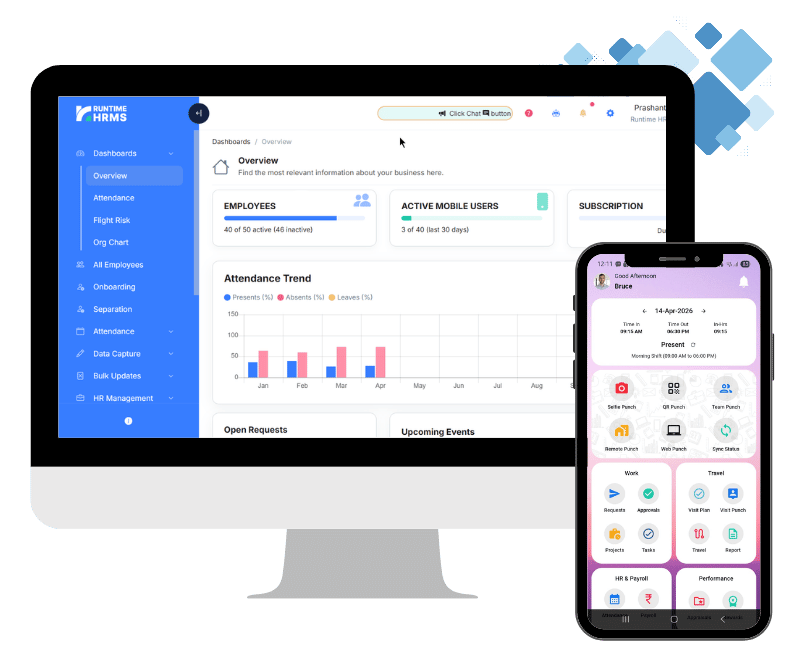
For organizations planning to grow across India, investing in the right HRMS like Runtime HRMS is not just about payroll efficiency. It’s about building a strong compliance foundation that supports long-term business growth.