

Quick Answer: What is Form 124 and how is it different from Form 12BB?
Form 12BB, the investment declaration salaried employees submit to their employer for TDS purposes, has been renumbered Form 124 under the Income Tax Act 2025, effective from Tax Year 2026-27. Key points:
- Legal basis moved from Section 192/Rule 26C to Section 392(5)(b)/Rule 205
- Chapter VI-A deductions are now split across Chapter VIII-A and VIII-B
- Only applies fully if you’re on the Old Tax Regime – under the New Regime (now the default), almost none of it is available
- New requirement: disclose your relationship to the landlord if claiming HRA on rent paid to a relative
It’s not legally mandatory to file, but skipping it means your employer deducts TDS on your full salary without factoring in any claims – and inflated declarations can attract penalties up to 200-300% of underreported tax under Section 270A.
Form 124 is short, usually a page or two, but it’s the single input that determines whether an employee’s monthly take-home pay reflects their actual tax position or whether they’re overpaying TDS for eleven months and waiting on a refund. What’s changed with the move to Form 124 isn’t the purpose – it’s still an employee telling their employer, “here’s what I plan to invest and claim this year, please calculate my TDS accordingly.” But a few of the specifics are different enough that treating this like a simple renumbering, the way some payroll teams are doing, misses real substance underneath.
What Form 124 Actually Covers
Part A of the form captures the basics – employee name, designation, address, PAN, contact details, and the relevant tax year. The declaration itself covers the same broad categories Form 12BB always did.
For HRA, employees declare rent paid and the landlord’s details – and as covered above, their relationship to the landlord if paying a relative. If annual rent exceeds ₹1,00,000, the landlord’s PAN becomes mandatory. For Leave Travel Allowance, employees declare the amount they intend to claim for travel undertaken during the block period. Home loan interest gets declared with the lender’s name, loan account details, and the interest certificate as supporting evidence. And the broader Chapter VIII-A and VIII-B deductions cover the range of investments and expenses that used to sit under Chapter VI-A – life insurance premiums, PF contributions, ELSS investments, health insurance premiums, and education loan interest, among others.
Does Form 124 Even Apply If You’re on the New Tax Regime?
Here’s the thing most guides skip entirely: if you’re on the New Regime – which is now the default unless you actively opt out – this entire form barely matters to you. No HRA exemption. No LTA. No home loan interest deduction on a self-occupied place. None of the Chapter VIII-A and VIII-B deductions for life insurance, PF, ELSS, or health insurance premiums. What’s left standing is short – the standard deduction (₹75,000) and the employer’s NPS contribution. That’s the whole list.
The Regime Lock
Once you tell your employer which regime you’re on, that choice is generally locked for the year’s TDS computation. No switching back and forth mid-year as your tax planning shifts. Worth taking seriously the first time, not treating as an afterthought on the same form as your HRA numbers.
Yes, You Can Revise It Mid-Year
Plans change. Someone moves into a rented flat in August that wasn’t on the radar in April. Someone makes an unplanned Section 80C investment in December. Most employers accommodate a revised declaration to reflect exactly this kind of shift, adjusting the remaining months’ TDS accordingly.
The Penalty Side
This is where the stakes go past “slightly higher TDS” and into real trouble. Overstate your rent, inflate an investment figure, claim a deduction you can’t actually back up – and you’re in Section 270A territory. Up to 50% of the underreported tax for ordinary underreporting. Up to 200-300% if it gets treated as deliberate misreporting.
There’s a quieter consequence too, beyond the direct penalty: an inflated declaration creates a mismatch the moment you file your ITR, since the numbers on record with your employer and the numbers in your actual return need to line up. A gap between the two is exactly the kind of thing that invites scrutiny.
What Happens If You Just Don’t Bother
Not legally mandatory, but the cost of skipping it is real enough that most employees shouldn’t. No declaration means your employer has nothing to factor in – tax gets deducted on your full salary as though HRA, home loan interest, and every Chapter VIII investment simply don’t exist. For anyone with meaningful claims in those categories, that’s a noticeably thinner monthly paycheck, recoverable only as a refund after next year’s ITR.
There’s a second risk worth naming: declaring investments you never end up making, or getting details wrong, can create complications when your actual return doesn’t match what was assumed during the year.
Free Download: Form 124 Investment Declaration Template
How Runtime HRMS Handles This
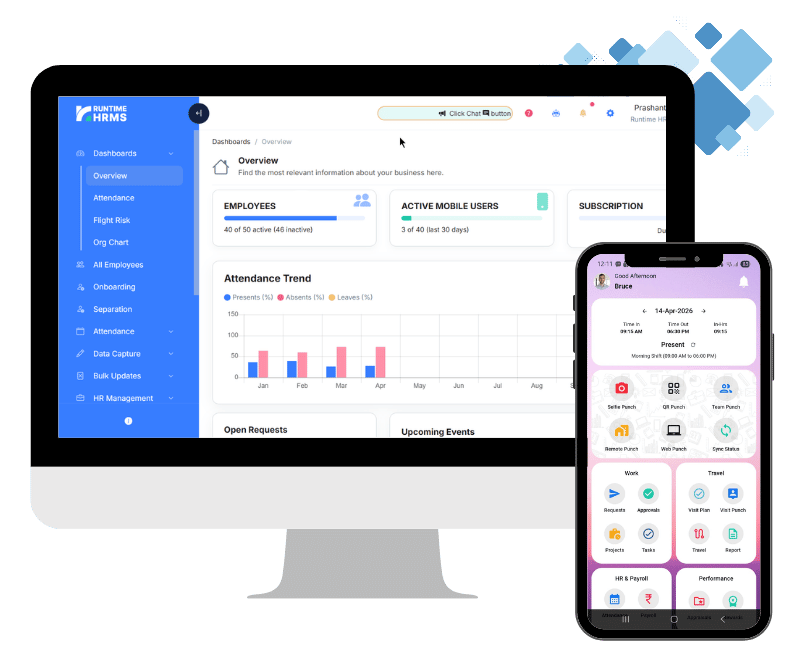
Collecting, tracking, and reconciling investment declarations across an entire workforce is exactly the kind of process that goes wrong quietly in a spreadsheet – a missed submission here, an outdated form template there. Runtime HRMS keeps investment declaration collection built into the payroll cycle itself, with the current form format and section references applied automatically, so TDS calculations stay accurate without HR having to manually track who’s submitted what.
Also Check:
Authorization Letter Format India