

Let’s be honest for a second.
You did not study HR, give interviews, and work hard to become an HR Manager — just to spend your entire day chasing employees for attendance, fixing salary errors in Excel, and answering “bhai meri payslip kahan hai?” on WhatsApp at 9pm.
But that’s exactly what’s happening, isn’t it? Believe me — you are not alone. Almost every HR manager in a small or mid-size company in India is living this same life. And the worst part? Nobody talks about it. Everyone just assumes HR managers are “managing fine.”
They are not. You are not. And that’s okay to admit. This article is for you — the HR manager who is tired, overwhelmed, and honestly just wants to do the real work. The work you actually signed up for.
So let’s talk about how you can get your time back. At least 10 hours of it. Every single week.
First — Let’s Talk About Your Typical Monday
You come in. Coffee in hand. Full of hope. And then it starts. Someone didn’t mark attendance on Friday. Someone else is asking why their salary was short last month. One employee wants a relieving letter from 3 years ago. Another one needs a salary certificate for a home loan — urgently, obviously. Your boss wants a headcount report by noon. And payroll closing is in 4 days.
By 11am, your to-do list from Sunday night is already forgotten. You are in firefighting mode. Again. Sound familiar? Yes, I thought so.
Here’s the truth — most of this chaos is not because you are bad at your job. It’s because you are doing your job with the wrong tools. You are trying to run a 2026 company with 2005 methods. Excel was not built for payroll. WhatsApp was not built for attendance. And you were definitely not built to spend 60% of your day on tasks that a software can do in minutes.
Where Are Your 10 Hours Going Every Week?
Let’s do a quick honest calculation. Think about how much time you spend every week on these:
| Task | Time Spent (Weekly) |
| Processing attendance manually | 3–4 hours |
| Answering employee queries (payslip, leave balance, documents) | 2–3 hours |
| Payroll calculations and cross-checking | 4–5 hours (salary week) |
| Preparing compliance reports (PF, ESI, TDS) | 2–3 hours |
| Creating HR letters manually (offer, increment, experience) | 1–2 hours |
| Chasing employees for forms, declarations, documents | 2–3 hours |
Add it up. That’s easily 15–20 hours every week on repetitive, manual, soul-crushing tasks. And how much time are you spending on the work that actually matters — hiring the right people, building a healthy culture, supporting your team, thinking about employee engagement?
Honestly? Maybe 2–3 hours. If you’re lucky. That’s not HR. That’s data entry with an HR designation.
What HR Managers Actually Want to Do?
Ask any HR manager what they actually love about their job — and nobody says “I love processing attendance in Excel.”
What they say is:
- “I love finding the right person for the right role.”
- “I love when an employee comes to me with a problem and I can actually help.”
- “I love building a culture where people enjoy coming to work.”
- “I love when my inputs actually influence how the company grows.”
That’s real HR. That’s the work that makes you feel good at the end of the day. But right now, you barely have time for any of it — because manual processes are eating you alive. The good news? You can change this. And it’s not as complicated as you think.
5 Ways HR Managers Can Save 10+ Hours Every Week
1. Stop Processing Attendance Manually — Let the App Do It
If you are still collecting attendance from registers, Excel sheets, or WhatsApp messages — stop. Right now.
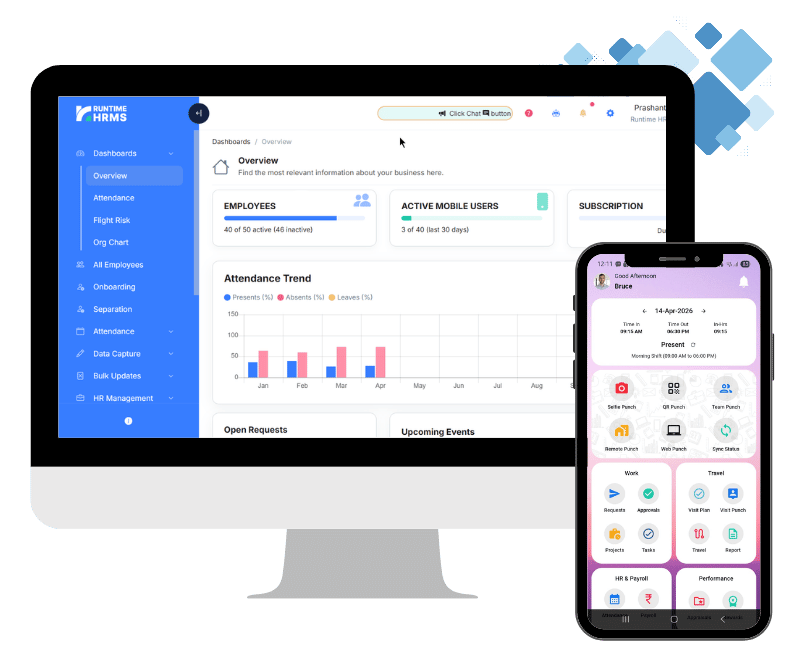
A good HRMS like Runtime HRMS lets employees mark attendance directly from their mobile — with geo-tagging so you know exactly where they were. Field employees? GPS tracked. Office employees? Geo-fenced. Biometric integration? Supported.
You don’t chase anyone. You don’t compile anything. The system does it automatically and generates reports whenever you need them.
Time saved: 3–4 hours every week. Just like that.
As per Ministry of Labour & Employment, India, every establishment with 20+ employees must maintain proper attendance and wage records.
2. Let Employees Answer Their Own Questions
“What is my leave balance?” “Can you send me my payslip for March?” “I need a salary certificate.” “When is my next increment due?”
These questions are not wrong. Employees have every right to ask them. But answering the same questions 20 times a week is not what you should be doing with your time.
With an employee self-service app, your employees can check their own payslip, leave balance, attendance history, and download HR letters — without messaging you. Ever.
Runtime HRMS has a mobile app called Runtime Workman where employees handle all of this themselves. You get notified only when something actually needs your attention.
Time saved: 2–3 hours every week. Plus — no more 9pm WhatsApp messages. Priceless.
3. Automate Payroll — And Stop Exhausted Yourself in Salary Week
Salary week should not be the most stressful week of your month. But for most HR managers doing payroll manually in Excel — it absolutely is.
Wrong formulas. Missed deductions. New joiners not added. PF calculated wrong. Someone got extra leave encashment by mistake. And then — the salary goes out, and the complaints start.
With automated payroll, you set up the salary structure once. Every month, the system calculates everything — basic, HRA, allowances, PF, ESI, TDS, Professional Tax, LOP deductions — automatically. You review, approve, and done.
No more cross-checking row by row. No more 2am salary nights.
Time saved: 4–5 hours every salary cycle.
4. Stop Creating HR Letters From Scratch Every Time
Offer letter — open Word, change name, change designation, change date, change salary, pray you didn’t miss anything, save, convert to PDF, send.
Repeat this 10 times a month. For offer letters, increment letters, experience certificates, relieving letters, warning letters…
With HR software, these are all templates. You fill in the employee name, click generate, and the letter is ready in 30 seconds. Professional format, company letterhead, everything.
Time saved: 1–2 hours every week. And zero formatting errors.
5. Get Compliance Reports in One Click
PF challan. ESI challan. TDS workings. Professional Tax. Form 16 at year end.
If you are preparing all of these manually — you already know the pain. Hours of work. High chance of errors. And the constant fear of getting it wrong. A good HRMS generates all statutory compliance reports automatically — based on the payroll data already in the system. You just click, download, and file.
Time saved: 2–3 hours every week. And more importantly — peace of mind.
According to EPFO India, any delay in PF deposit attracts a penalty of 12-25% per annum — which is exactly why accurate payroll processing matters.
What Your Week Looks Like After All This
Remember that Monday we talked about earlier?
Here’s what it looks like when you have the right tools:
- Someone didn’t mark attendance — the system flagged it automatically, employee got a notification.
- Employee asking about salary — they checked it themselves on the app.
- Relieving letter request — generated in 30 seconds.
- Salary certificate for home loan — employee downloaded it themselves.
- Headcount report for your boss — exported in one click.
- Payroll closing in 4 days — 80% already done, just needs your final review.
You have your coffee. You actually finish it while it’s still hot. And by 11am — you are working on that hiring plan you’ve been meaning to start for 3 months. That’s not a dream. That’s just what happens when you stop fighting your tools and start using the right ones.
You Deserve Better Than This
Honestly — HR is one of the most important functions in any company. You deal with people’s livelihoods, their salaries, their careers, their emotions. That’s a huge responsibility.
But somewhere along the way, the job got buried under paperwork, Excel sheets, and WhatsApp messages. And the real, meaningful HR work got pushed to “whenever I get time” — which is never. You deserve better than that. Your employees deserve an HR manager who has time for them — not one who is always neck-deep in manual work.
The good news is — fixing this is not hard. It doesn’t need a big budget. It doesn’t need months of implementation. Runtime HRMS starts at just ₹59 per employee per month. For a 40-person team, that’s ₹2,360 per month. Less than what most companies spend on office snacks.
And it comes with a free trial — no credit card, no commitment. Just set it up, use it for a month, and see how much time you get back.
Book a Free Demo — See How It Works →
Start Your Free Trial — No Credit Card Required →
Quick Summary — What You Can Automate Starting Today
- Attendance — mobile app, geo-tagged, automatic reports
- Employee queries — self-service app, no more WhatsApp messages
- Payroll — automated calculation, one-click processing
- HR letters — templates, 30 seconds per letter
- Compliance reports — PF, ESI, TDS, PT — one click
Total time saved: 10–15 hours every week. Every single week.