
Quick Answer: What are the new Labour Codes in India and what changed?
On November 21, 2025, India implemented four Labour Codes replacing 29 old labour laws:
- Code on Wages 2019 – salary structure, minimum wages, overtime
- Industrial Relations Code 2020 – hiring, termination, fixed-term employment
- Code on Social Security 2020 – PF, ESI, gratuity, maternity, gig workers
- OSH Code 2020 – working hours, leave, safety, appointment letters
What every employer must do right now:
- Restructure salary – basic must be minimum 50% of CTC
- Issue appointment letters to every worker – now legally mandatory
- Update FnF process – settlement within 2 working days
- Extend gratuity to fixed-term employees after 1 year
- Register gig and platform workers under social security
Most employers I speak to know about the New Labour Codes India changes but very few know exactly what.
29 labour laws that had governed Indian employment for decades, some of them written in the 1920s and 1940s that were replaced overnight by four unified Labour Codes. The government called it the most significant labour reform since independence. And they weren’t wrong.
This guide is not a legal textbook or nor a government circular, this guide is a practical, employer-focused breakdown of what the four Labour Codes actually changed, and what you need to do about it.
The New Labor Codes That Are Important To Know
India’s previous labour framework had 29 separate laws, that old system was genuinely difficult to navigate. Now, instead of 29 separate laws, the four new labor code simplify this. One law for wages. One for industrial relations. One for social security. One for safety and working conditions. Unified definitions. Unified compliance timelines. Unified enforcement.
Let’s take 4 labour codes one by one:
Code 1: Code on Wages 2019
Basic wages + DA must be minimum 50% of total CTC. If allowances exceed 50%, the excess is treated as wages, increasing PF, ESI, and gratuity calculations automatically.
Key changes:
The 50% Basic Wage Rule: This is the biggest payroll change. In this rule if your salary structure has basic at 30-40% of CTC, it is non-compliant. Restructure immediately because higher basic means higher PF and gratuity, but also higher statutory protection for employees.
The Universal Floor Wage: That means every business owner has to pay fixed minimum wage, according to the rule. States can set higher wages but not lower than minimum wages. It affects businesses for employing workers near minimum wage levels.
The FnF in 2 Working Days: In this rule the Full and Final Settlement must be completed within 2 working days of last working day of an employee. The old 30-45 day practice is legally non-compliant.
Consistent Payroll Date: This is the most interesting rule, salaries must be released on the same date every month to employee. Delays in salary disbursement can attract interest and penalties.
📺 Want the full breakdown? Watch how the new Labour Code’s 50% wage rule impacts your PF calculation:
Code 2: Industrial Relations Code 2020
Fixed-term employees now get the same benefits as permanent employees. Layoff threshold raised to 300 workers. Standing orders mandatory for 300+ worker establishments. Dispute resolution through Industrial Tribunals with defined timelines.
Key changes:
The Fixed-Term Employment: This rule says that no business can use Fixed-term contracts to avoid statutory benefits like PF, ESI, gratuity (after 1 year), and statutory bonuses. After this rule businesses should change the Fixed-term contracts to standard employment (after 1 year).
are now a standard employment type with full benefit parity. PF, ESI, gratuity (after 1 year), and statutory bonuses all apply proportionately. You can no longer use fixed-term contracts to avoid statutory benefits.
Standing Orders: In this rule companies those have 300+ workers must maintain model standing orders covering employment terms, disciplinary processes, and grievance mechanisms is now including fixed-term and gig workers.
Layoff Threshold: According to this rule a business cannot do mass layoff without Government permission for above 300 workers (previously 100). More flexibility for medium-sized companies but documented justification, notice, and retrenchment compensation of 15 days’ wages per year of service still required.
Code 3: Code on Social Security 2020
Gratuity eligibility for fixed-term employees reduced from 5 years to 1 year. Gig and platform workers brought under social security for the first time. PF, ESI, maternity benefit, and gratuity consolidated under one framework.
Key changes:
Gratuity After 1 Year: In this rule the fixed-term employees are eligible for pro-rata gratuity after just 1 year of service. Here is the formula: (Basic + DA) × 15 × Years ÷ 26. If you use fixed-term contracts, provision gratuity from Year 1.
Gig and Platform Workers: Delivery executives, freelancers, and platform workers are now recognized under social security law. Employer and aggregator obligations are being defined through state-level rules and track these as they are notified.
EPF Scheme 2026: Effective June 29, 2026, EPF Scheme 1952 replaced by EPF Scheme 2026. All members auto-transitioned. UAN-Aadhaar-PAN linkage now mandatory for all PF transactions. Pension claims must settle within 20 working days.
Maternity Benefit: 26 weeks paid maternity leave remains unchanged. New additions is WFH arrangements for an employee may be offered post-leave for suitable roles.
Code 4: Occupational Safety, Health & Working Conditions Code 2020
Written appointment letters are now mandatory for every worker in India, no exceptions. Working hours capped at 8 hours/day, 48 hours/week. Annual health checks mandatory for employees above 40.
Key changes:
Appointment Letters: Appointment letter is mandatory for every worker that are permanent, contract, fixed-term, daily wage, gig. According this rule every worker must receive a written appointment letter with specifying designation, wages, working hours, leave entitlement, and notice period. If you haven’t issued appointment letters to all workers since November 2025, you are non-compliant right now.
Working Hours and Overtime: Maximum 8 hours/day, 48 hours/week. Overtime capped at 2 hours/day. For factory workers, January 2026 SC ruling confirmed overtime must be calculated on Basic + DA + all allowances not just Basic + DA.
Annual Health Checks: Employees above 40 years are entitled to free annual health check-ups. New employer obligation set up a process if you haven’t already.
Workplace Safety: This rule means to provide safe work environment to employees like more safety committee, safety officer, and audit requirements for larger establishments and hazardous industries.
What Runtime HRMS Updated Automatically
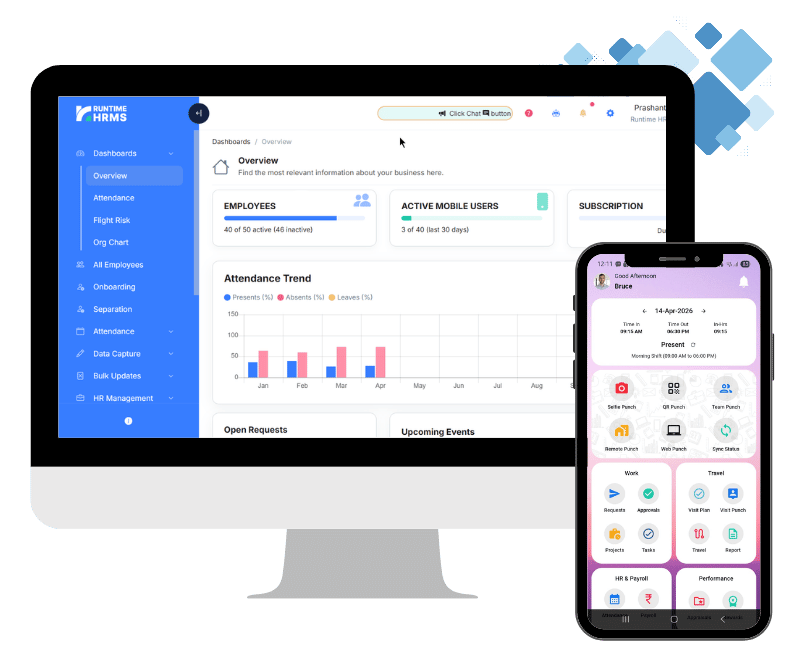
Runtime HRMS updated its payroll engine, compliance reports, and FnF calculations for all four Labour Codes, so businesses using the platform don’t have to track regulatory changes manually.
When the Labour Codes came into effect on November 21, 2025, and when the EPF Scheme 2026 came into force on June 29, 2026, Runtime HRMS updated automatically.
That’s why Runtime HRMS is easy to use and always stay updated your organisation compliance ready
Employer Compliance Checklist: Do This Now
Wage Code:
- Review all salary structures, basic must be minimum 50% of CTC
- Update payroll configurations for new wage base
- Ensure consistent monthly payroll release date
- FnF within 2 working days of last working day
Industrial Relations Code:
- Update fixed-term employment contracts to ensure benefits parity
- Review and update standing orders (300+ worker establishments)
- Document all employment terms in writing
Social Security Code:
- Provision gratuity for fixed-term employees from Year 1
- Ensure EPF Scheme 2026 compliance, UAN-Aadhaar-PAN linkage
- Track state-level gig worker rules as they are notified
- Verify ESI coverage for all eligible workers on correct wage base
OSH Code:
- Issue appointment letters to every worker, including contract and daily wage
- Review overtime calculation for factory workers
- Set up annual health checks for employees above 40
- Review workplace safety documentation and committees
Check the latest update on: EPFO