
Quick Answer: What Is the Difference Between PT and LWF?
Professional Tax (PT) is a state tax on employment income, capped at ₹2,500 per person per year, which the employer deducts from the employee’s salary and deposits with the state.
Labour Welfare Fund (LWF) is a state welfare contribution paid by both the employee and the employer into a State Labour Welfare Board, usually as small fixed amounts at half-yearly or annual intervals.
Professional Tax vs Labour Welfare Fund both involved state-level rules, but their purpose, coverage and calculation are different. Setting up one does not settle the other. They both are tiny amounts and easy to get wrong without anyone noticing for months.
As a director at Runtime HRMS, my view is that these two deserve to be read side by side, because they fail in the same way. Both are state subjects. Both change without much announcement. Both are easy to configure once and then forget. And when something is off, the employee rarely complains about a ₹200 deduction, so the mistake survives until an inspection, or a state notice brings it up.
That is what this guide is for: what each one is, where they differ, which states they cover, and how to avoid the usual mistakes.
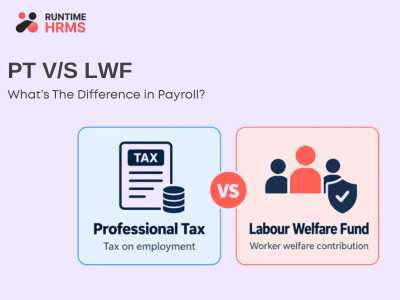
Professional Tax vs Labour Welfare Fund
One difference matters more than the rest. With PT, the employer is only the collecting agent; the money comes out of the employee’s pay. With LWF, the employer pays a share on top, and that share is usually two to three times what the employee pays.
Why One Payroll Setting Is Not Enough
My recommendation is to review PT and LWF as two separate obligations.
For PT, ask:
- Which jurisdiction’s rules apply?
- Which salary slab or category applies?
- Does the employee qualify for an exemption?
- What are the payment and reporting requirements?
For LWF, ask:
- Is this establishment covered?
- Is this employee eligible under the relevant law?
- What are the employee and employer shares?
- Which contribution period and due date apply?
A correct PT calculation does not establish that LWF has been handled correctly.
Example: Employee Deduction vs Employer Contribution
Maharashtra’s Labour Welfare Fund framework provides a useful illustration.
For an eligible employee covered by the relevant provisions, the half-yearly contribution is:
| Contribution | Amount |
| Employee share | ₹25 |
| Employer share | ₹75 |
| Total contribution | ₹100 |
The employee’s deduction is ₹25, not ₹100. The remaining ₹75 is the employer’s contribution.
For 20 eligible employees in one contribution period:
Employee deductions: 20 × ₹25 = ₹500
Employer contribution: 20 × ₹75 = ₹1,500
Total remittance: ₹2,000
This example illustrates the separation of the two shares. Eligibility and the contribution-period requirements still need checking before applying it to a payroll.
What It Looks Like on an Actual Payslip
PT shows up as a deduction almost every month. LWF appears only in the periods your state notifies, which is why it gets missed.
Take an employee in Maharashtra with a gross salary of ₹32,000. Under the Maharashtra slab for men earning above ₹10,000, PT is ₹200 a month and ₹300 in February, which adds up to ₹2,500 for the year. That is the constitutional maximum, and it comes straight out of the employee’s pay. You can check your own state and salary with our Professional Tax Calculator.
Now LWF. For illustration only, assume a state with ₹25 from the employee and ₹75 from the employer, collected half-yearly. Please check your own state’s current rate before using this. The employee sees a ₹25 deduction twice a year. The employer pays ₹75 per employee on top. With 40 employees, one half-yearly cycle comes to ₹1,000 from employees and ₹3,000 from the company, ₹4,000 in total.
This is where the difference in effort sits. PT is on every payslip, so someone notices it. LWF turns up in one or two months of the year, so it depends on your payroll system remembering, or on someone’s calendar.
Which States Charge Each One?
It depends on the state where the employee works. There is no national list you can safely copy.
For PT, around twenty states and union territories levy it. Delhi, Haryana, Uttar Pradesh, Rajasthan, Uttarakhand, Himachal Pradesh, Chandigarh, Goa, Jammu and Kashmir and Arunachal Pradesh are generally listed as not levying it, and Odisha joined that list from 1 April 2026. Even this list has grey areas. Punjab is a good example: Runtime’s own Professional Tax guide lists a Punjab slab, and at least one other source says it levies a PT-style tax under a differently named 2018 Act, while several calculators list the state as exempt. That is exactly why I would not trust any single table, including this one, over the state’s own notification. For the full state-by-state slabs, use that guide as a starting point and confirm against the notification.
For LWF, around sixteen states and union territories have an Act in force, and applicability depends on the state where your employees work, not where the company is registered. Some states also apply it only above a headcount threshold, and those thresholds have been revised in places.
If you have employees in more than one state, the safe way to work is simple. For every employee, record the state of work. For every state, check two things separately: does PT apply, and does LWF apply. Do not assume that one implies the other.
What Changed Recently
Odisha stopped PT from April 2026, Karnataka’s February rate went up, and several LWF rates were revised.
Odisha repealed its PT law by an ordinance gazetted on 21 April 2026, with effect from 1 April 2026. Deductions from April 2026 salaries should stop. Liabilities and returns for periods before that date continue to apply under a savings clause, so earlier filings do not disappear. Employers who kept deducting after April will need to reconcile. One caution: this is an ordinance, and an ordinance has to be converted into an Act by the legislature. Check the current status with the Odisha Law Department before treating it as permanent.
In Karnataka, PT is nil below ₹25,000 a month and ₹200 at ₹25,000 and above, with February at ₹300 so that the annual total reaches ₹2,500. Some older calculators still show a lower threshold, so check which version you are using.
On the LWF side, sources report that Maharashtra raised its rates in March 2024 and Haryana revised its monthly caps from 1 January 2026. A few states have also reported changes to rates or thresholds recently. Rates in this area move often, and the articles that rank on search results are sometimes a year behind.
Mistakes That Lead to Notices
The most common one is using the head office state for everyone instead of each employee’s state of work. A close second is deducting PT in a state where it does not apply, or failing to deduct it where it does, usually after a transfer that nobody updated in payroll. With LWF, the usual miss is simply forgetting that it exists, because there is no monthly reminder. Another is applying an old rate after a revision, and Odisha and Karnataka are recent examples. And with both, late payment tends to cost more than the amount involved.
PT & LWF Payroll Checklist
Before processing PT and LWF, check these six points for your employees.
How Runtime HRMS Handles PT and LWF
Everything in this guide comes down to one habit: knowing, for every employee, which state’s rules apply and which month something falls due. Carrying that in a spreadsheet works until the first transfer, the first state notification, or the first month someone is on leave.
Runtime HRMS runs payroll with statutory deductions, including Professional Tax, inside the same payroll run as PF, ESI and TDS, so PT is calculated with the rest of the salary instead of sitting in a side sheet.
Managing PT, PF, ESI & TDS Manually?
Runtime HRMS brings payroll and statutory deductions into one system, helping HR teams calculate salary and applicable deductions without maintaining separate payroll sheets.
Book Your DemoFrequently Asked Questions
Are PT and LWF the same deduction?
No. PT is a tax, while LWF is a welfare-fund contribution. Their coverage, calculation and payment requirements are separate.
Can both apply to the same employee?
Yes, where the employee and establishment satisfy the respective rules. Applicability under one does not determine applicability under the other.
Is LWF deducted every month?
Not necessarily. Follow the contribution cycle prescribed by the relevant state rules.
Can the employer recover its LWF contribution from the employee?
The employee deduction should reflect the prescribed employee share. The employer contribution must be accounted for separately.
Check Our Other Useful Resources
For official references: Ministry of Labour and Employment | Income Tax Department
Disclaimer
This guide is for general information and reflects the position as understood at the time of publication. PT and LWF are governed by state laws that change frequently, and sources sometimes disagree, so the rates, thresholds and due dates mentioned here should be confirmed against the current state notification before you use them in payroll. For specific cases, consult your CA or a compliance professional.