
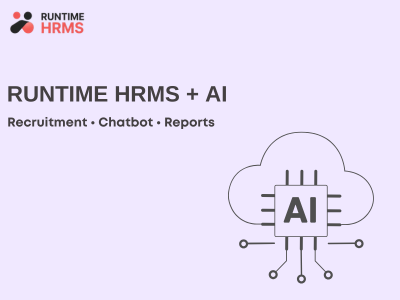
AI is entering in many fields, and HR is one of them, because HR teams are already using AI for practical work such as creating job descriptions, screening resumes, communicating with candidates and automating repetitive tasks.
But there is something I have always found important when we talk about AI in HR:
AI is useful only when it actually makes an HR person’s work easier.
You don’t need AI just because every software company has started putting an “AI” button somewhere. At Runtime, we think differently. The goal is simple:
Less searching, less repetitive work and faster access to useful HR information.
That’s exactly the kind of task AI is actually good at, and in Runtime AI replaces genuinely repetitive manual work, not as a feature checkbox. Let’s look at what that actually means.
AI in Recruitment: The AI-powered ATS
This is where the productive time gets saved, AI can remove repetitive work. Think about what happens when HR has a new vacancy.
Someone has to understand the requirement, write the job description, decide what skills are important, review incoming resumes and start separating relevant profiles from irrelevant ones. A lot of this work is repetitive.
Our ATS is being built with AI-assisted recruitment workflows around exactly these areas.
AI-assisted Job Description
Instead of creating manual JD every time, HR can use AI to help structure the job description around the role, responsibilities and required skills. Here, one thing needs to remember that AI is helping create the first version of JD. The recruiter OR HR still decides whether the JD accurately represents the actual job or not and also edit it manually.
AI-assisted Resume Analysis
This problem is much bigger than earlier. A single job post may receive dozens of resume and reading each resume manually and comparing every profile with the job requirements takes considerable time. AI can help analyse resumes and identify relevant information much faster.
That doesn’t mean, AI says this candidate is good, so hire them
The AI helps HR to get shortlist profile out of 100 resumes. The final decision remains with the recruiter or HR. This is where AI makes sense: let technology handle the repetitive first layer, and let HR spend more time on people, interviews and actual evaluation.
Our ATS is being introduced as a dedicated part of Runtime’s recruitment workflow. We’ll cover its complete features separately in our ATS product page and upcoming articles.
AI Chatbot: HR Answers Without Another Search
HR receives many questions all day, some are complex that requires HR knowledge, but some are repetitive like leave-balance question or policy query or something else. And that’s where our AI Answering Bot comes in.
Every Runtime HRMS account includes a built-in 24×7 AI chatbot for employees and HR. So, employees can ask the chatbot directly and get an answer immediately, without waiting on someone to be free. It helps to reduce the number of repetitive questions that unnecessarily interrupt the HR work.
Because a good HR system should give HR professionals more time for:
- Employee Conversations
- Recruitment
- Performance Discussions
- Policy Decisions
- Workforce Planning
Rather than spend HR Day answering the same basic questions again and again.
AI Reporting: Ask for the Report Instead of Building It
This is the area where you can see difference between traditional HR software and Runtime HRMS AI-assisted software.
Runtime HRMS comes with 50+ built-in MIS reports covering salary, attendance, compliance, taxation and other HR information. Normally, HR knows what information they need, but finding the right report, applying filters and preparing a customised view can still take time.
So, we added another layer. AI Reporting, instead of thinking, which report should I open? HR can think what information do I need? For example:
“Show department-wise salary cost for this month.”
Or:
“Show employees with overtime above 20 hours.”
Or:
“Give me a headcount summary by department.”
Or:
“Show attendance data for the sales team.”
That means you’re not learning where a report lives in the menu structure or which filter combination produces it; you’re just asking for the output, the same way you’d ask a colleague who already knows the system. And honestly, this is one of the most practical applications of AI in HR. Because HR professionals don’t think in database queries. They think in questions and AI give those questions answers.
Why We Put AI Inside Runtime HRMS?
Runtime is already designed around employee information, attendance, leave, payroll, compliance and reporting. So, our goal isn’t to add AI as a separate toy sitting beside the HRMS. We want AI to become another way of interacting with the work HR is already doing.
See Runtime HRMS with AI in Action
AI is most useful when it makes everyday HR work simpler. See how Runtime brings AI-assisted recruitment, employee support and reporting together in one HRMS.
Book a DemoDoes AI Replace the HR Manager?
The simple answer is NO. And it shouldn’t. Because AI can:
- Help create a job description.
- Help analyse resumes.
- Help answer routine questions.
- Help generate reports.
But deciding whether a person is right for a role, handling a sensitive employee matter, interpreting a policy, resolving a conflict, making workplace happier or making a people decision, that all require HR.
Final Thoughts
AI can automate or assist with repetitive HR tasks, but HR decisions still require human judgment, context and empathy. At Runtime, we’re trying to use each technology where it genuinely makes the HR team’s work easier.
Recommended Reading
Want to explore more about AI, automation and modern HR technology? These resources may help.