

Quick Answer
Payroll software for security agencies has to handle shifts first. It should let you roster guards by site and day, record attendance at sites with no office, calculate overtime and double duty, and run PF and ESI with the salary.
Runtime works as payroll software for security agencies. It supports shift rosters (with bulk edits and Excel import), geo-tagged remote punch and automatic overtime, with payroll and statutory deductions in the same system. Try it with a test month of your own guards.
For a security agency, payroll is a roster problem
A shop owner pays staff for the days they came. A security agency pays guards for the shifts they covered, at sites the owner may not visit for weeks.
That is why payroll software for security agencies is a different thing from payroll software for an office. In an office, attendance is simple and salary is the hard part. In an agency, salary is just arithmetic. The hard part is knowing, with proof, who stood where and for how long.
This guide is for agency owners and operations heads looking at payroll software for security agencies. It covers the problems I hear most, why they matter, what to look for, and a free roster sheet. I am not a lawyer or a CA, so check legal details with yours.
Is this you?
Read these six. If three feel familiar, the problem is not your payroll. It is everything that feeds it.
- It is the 28th and attendance is still arriving on WhatsApp. Supervisors send photos of registers, some clear, some not. Someone types them into a sheet, and a night shift gets counted on the wrong date. Guards wait for wages while you wait for data.
- The relief did not turn up, so a guard did a double. It was never in the roster. He expects extra pay, and you hear about it on the 30th. Now it is an argument about a duty nobody wrote down, and the guard remembers who won.
- The client asks who was on post on the 14th. You have a register that says one thing, a supervisor who remembers another and a guard who is not sure. Whatever you cannot prove is whatever they deduct from the invoice.
- What the client pays and what you pay never match. The client pays for posts. You pay for guards, plus relief, plus overtime. When wage revisions arrive and the contract rate does not move, the gap grows quietly. You see it only at year end.
- Guards ask for wages before the 7th and you are still collecting data. Late wages are not a small problem in this business. Guards leave, you find replacements, you train them, and the new ones make the same mistakes.
- A client asks for PF and ESI proof and it takes days. As principal employer they have their own reasons to ask. If the answer takes a week, the next question is whether to renew.
What this costs you
Suppose collecting attendance, building the roster and working out overtime takes you or your accountant two working days every month. That is 24 days a year. Then add what you cannot see on a timesheet: one disputed invoice, one guard who leaves over late wages, one client who asks for proof that you cannot find. A single one of these can cost more than the software.
Why payroll software for security agencies matters
At five guards on one site, a register and a spreadsheet can work. It stops being enough sooner than most owners expect. Here is why.
1. Your product is shifts, and payroll is where shifts turn into money. If the roster is wrong, the wages are wrong, and so is the invoice. Fixing the roster fixes all three.
2. Guards judge you by the date wages arrive. On time, every month, with a payslip that matches the duty they did, is how they decide whether to stay. Software closes the gap between the last duty and the payment.
3. Clients buy proof. The agency that can show who was on post, with time and place, wins audits and renewals. The agency that cannot is the first to be questioned on a bill.
4. Doubles and overtime are real costs. They need to be seen daily, not discovered at month end. Under the Code on Wages, overtime is paid at not less than twice the normal rate of wages, so a few unrecorded hours matter.
5. Statutory rules fall heavily on guards. Most guards earn within the ESI limit. PF applies from 20 employees. Wages are due before the 7th. When these slip, the notice may come to you, or to your client as principal employer. See what to do about a PF or ESI notice.
6. Each new site adds work, unless the process scales. On paper, a new site means another register, another supervisor and another WhatsApp group. With the right software it means another row on a roster you already run. That is why some owners tell me growth only felt safe once the system was in place.
What one customer told us
A security agency using Runtime told us:
“Sir, ever since we started using your payroll software, we have grown every year. Roster and shift problems are a part of our business, but because of your software we have never run into any issue. In fact, we are now leading in the market.”
Their words are about growth, not about software alone. Growth has many causes. What I take from it is that rosters and shifts do not go away as an agency grows, and that having them under control is what makes the next site a roster decision instead of a risk.
What payroll software for security agencies should do
If the reasons above fit, this is the checklist I would use. Good payroll software for security agencies should cover each one.
- Roster by site and day, with bulk edits, so a change of shift is one action and not twenty messages.
- Record attendance where the guard stands, with location, even at a site with no office or device.
- Handle doubles and overtime with rules per shift, not a calculator at month end.
- Run wages and statutory deductions together: PF, ESI and Professional Tax from the same data as the roster.
- Give guards their own view of attendance and payslips on a phone, so questions do not all reach you.
- Keep records you can show a client without rebuilding them.
- Grow with sites: more guards and more locations should not mean more manual steps.
The rules that follow guards’ wages
These are the rules payroll software for security agencies has to apply for you.
| Area | What to remember |
|---|---|
| Overtime | Paid at not less than twice the normal rate of wages under the Code on Wages. Quarterly caps vary by state. |
| Wage deadline | Monthly wages before the 7th of the next month. A guard who leaves is to be paid within two working days. |
| ESI | Most guards earn up to ₹21,000, so most are covered once you have 10 employees. Some states start at 20. |
| PF | Mandatory from 20 employees, with the wage ceiling at ₹25,000. |
| Minimum wages | Set by the state, often by skill category. Check the current notification for guards in your state. |
| Deductions | Total deductions in a wage period are capped at 50% of wages. Keep uniform and advance recoveries within that. |
| Licences | Security agencies need a licence under the Private Security Agencies (Regulation) Act, and contractor rules may apply under the OSH Code. Check with your licensing authority and advisor. |
Clients also look closely at your PF and ESI payments, because as principal employer they may be answerable for gaps.
How to run shifts without chaos
Whatever tool you use, payroll software for security agencies only works if the shift process behind it is clean. This is the routine I would follow.
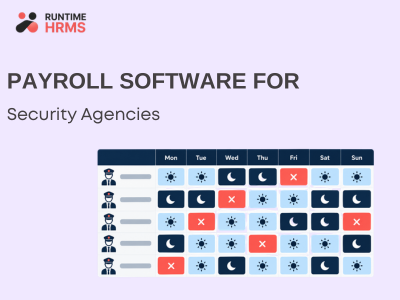
- Roster by site and day. One grid, guards down the side, days across, a shift code in each cell (D for day, N for night, OFF).
- Plan relief first. For every post, name who covers a weekly off before the month starts.
- Record attendance where the guard stands. A geo-tagged punch from the post is proof for the client and for payroll.
- Close overtime daily. Do not rebuild it on the 28th from memory.
- Send the roster and attendance into payroll once. No retyping.
How Runtime works as payroll software for security agencies
Here is how Runtime handles it.
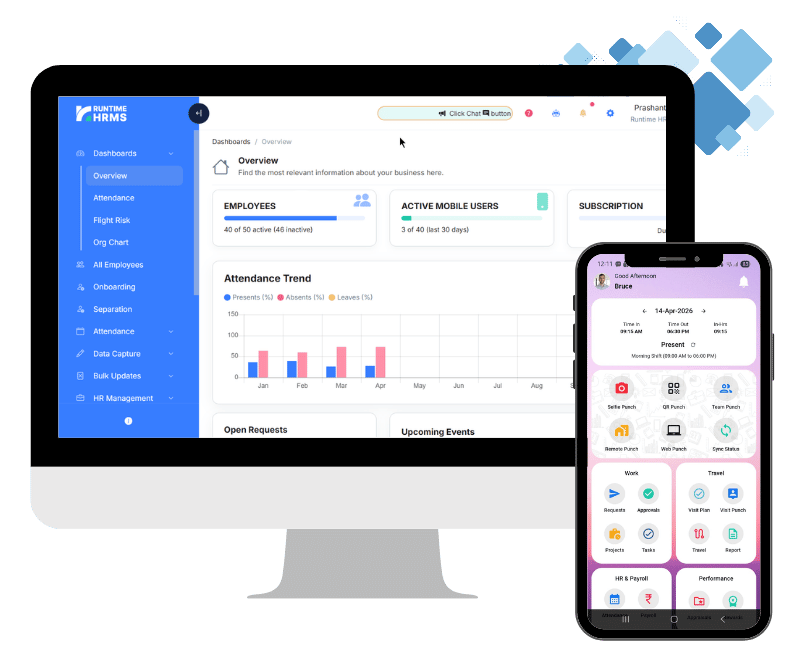
- Shift rostering. Assign different shifts to different dates, weekly or daily, update in bulk and import from Excel. Guards can request a shift change through the app, and the roster updates work time, overtime and late or early rules. See Time & Attendance.
- Remote punch. Remote workers and field staff submit geo-tagged punches, so a guard can punch from the post with the location recorded. There is also a setting to allow punches only from the employee’s location.
- Selfie punch. Through the Workman app, with face recognition. Admin enables it and each guard registers a face.
- Automatic overtime. Overtime from hours worked, with per-shift rules and multipliers such as 1.5x or 2x, and work on weekly offs and holidays.
- Biometric. Where a site does have a device, it can sync to Runtime. Runtime Lens adds touchless face attendance for offices or depots.
- Payroll. PF, ESI, Professional Tax and TDS run with the salary in Runtime Payroll.
Guard shifts still on paper and WhatsApp?
See payroll software for security agencies on your own data. Run a test month with your guards and sites.
Book Your DemoFAQs
How do security agencies manage guard shifts with payroll software?
Most use a roster by site and day with shift codes. Software lets you update it in bulk, import from Excel and record attendance from the post.
How is overtime calculated for security guards?
Overtime is paid at not less than twice the normal rate of wages under the Code on Wages. State caps vary, so check yours.
Is PF and ESI applicable to security guards?
Yes. ESI generally applies to staff earning up to ₹21,000 once you reach 10 employees (20 in some states), and PF applies from 20 employees.
How can I record guard attendance at client sites?
Use a geo-tagged mobile punch from the post, with selfie face recognition if you want proof of identity. A paper register is hard to defend.