

Quick Answer
When a PF or ESI notice arrives, do not ignore it and do not pay blindly. Note the section and the reply date, find out which type of notice it is, collect your records for that period, and reply in writing before the date.
Most notices are mismatches between what payroll shows and what was paid. Match your challans month by month before you answer, and bring in your CA early.
PF or ESI Notice Received? It is easy to ignore in the first hour and hard to fix in the last week. I have seen owners put it in a drawer because “the CA will handle it” and then find out the reply date passed three weeks ago.
If you have just received one, take a breath. Most are not a sign that you did something wrong on purpose. A late challan, a mismatch between an ECR and the amount paid, a missed employee, or a rule that changed mid-month is enough. This post is a plan for a PF or ESI notice, in the order I would do it. For the late-payment rates, see the PF and ESI registration guide. Here we deal with the notice itself.
I am not a lawyer or a CA. This is general information. Confirm what applies to you with yours.
| From | Notice | What it means |
|---|---|---|
| EPFO | Inquiry (Section 7A) | The officer is checking whether PF was due and for how much. You are asked to bring records. |
| EPFO | Damages (Section 14B) | A late-payment charge is being proposed. A hearing is usually offered. |
| EPFO | Interest (Section 7Q) | Interest at 12% a year is being demanded on late contributions. |
| ESIC | Show cause (Form C-18) | ESIC proposes an amount and asks why it should not be fixed against you. |
| ESIC | Order (Section 45A) | The amount is fixed. The appeal clock has started. |
| ESIC | Recovery (Sections 45C, 45G) | The amount is being recovered. It can include notice to your bank. |
Two things before you read further:
- The Labour Codes changed section numbers. The Code on Social Security replaced the ESI Act on 21 November 2025, and some sources now cite new section numbers for orders and appeals. Your notice will say which law it uses. VERIFY with CA
- The stage matters most. An early notice (inquiry or show cause) is a request for your side. An order or recovery notice has hard deadlines.
Why PF OR ESI notices arrive
These are the usual reasons. Check yours against the list.
- Challan does not match the ECR or the payroll. A short deposit, a wrong month, or a wrong amount.
- Late payment. The contribution was paid after the 15th.
- Employees missed. Someone was not registered, or was registered late.
- Wages treated differently. The officer counts allowances as wages, and you did not.
- The September 2026 ceiling split. The new ₹25,000 ceiling applied from 17 September, so September needs two calculations. A single calculation for the whole month can create a wrong demand. Our ceiling guide has the details. VERIFY with CA
- Contractors. An officer asks who is the principal employer.
- Old periods. A notice for years you thought were closed.
Step 2: The first 7 days after PF or ESI Notice
| When | What to do |
|---|---|
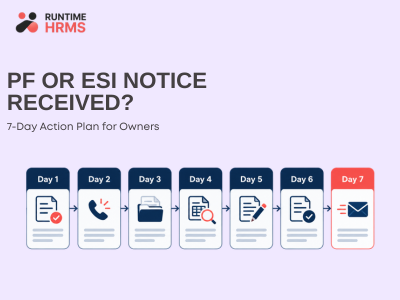
| Day 1 | Read the whole notice. Write down the section, the period, the amount and the reply date. Put the reply date in your calendar today. |
| Day 2 | Send the notice to your CA or compliance advisor. Do not pay the demanded amount before the numbers are checked. |
| Days 2 to 3 | Collect your records for the period named in the notice (list below). |
| Days 3 to 4 | Match each month: payroll figure, ECR, challan and bank payment. Mark every difference. |
| Day 5 | Draft the reply. Keep it factual: dates, amounts, documents attached, and what you ask for. |
| Day 6 | Review with your CA. Check every number again. |
| Day 7 | Submit before the due date. Keep proof of submission. Diary the hearing date. |
If you need more time, ask for it in writing before the date passes. Do not wait for the last day to find out you are missing a document.
Free download: PF and ESI Notice Response Kit
Download the Free Notice Response Kit (Excel)
It has a notice tracker with reply-date alerts, a document checklist, a month-by-month challan match sheet that shows short and excess deposits, and the 7-day plan above.
What to collect
- The notice and every annexure
- PF and ESI registration certificates
- Monthly ECRs and their receipts
- Challans and the bank statements that show payment
- Wage registers or salary sheets for the period
- List of employees with joining and exit dates, UAN and ESI IP numbers
- Attendance records
- Appointment letters and salary structures
- Contractor agreements and payment proof, if contractors are involved
- Earlier notices and your replies
Records scattered across Excel, email and a CA’s laptop are what slow most replies down.
What the reply should look like
Keep it short. A reply usually works in this order:
- Reference: notice number, date, establishment code.
- Your position in one or two lines.
- A month-by-month table of what was due and what was paid, with challan numbers.
- The explanation for any difference (for example, “paid on 18 March because of a bank holiday”).
- A list of documents attached.
- What you ask for: close the matter, or reduce the amount, or a hearing date.
Your CA or lawyer should sign off on the final text.
What not to do
- Do not ignore the date. An unanswered notice can turn into an order against you.
- Do not pay the full demand without checking. You may pay more than you owe.
- Do not hide or alter records. It turns a payroll mistake into a serious problem.
- Do not argue with the officer by phone and skip the written reply. Only the written reply counts.
- Do not deduct PF or ESI from employees and fail to deposit it. That is the hardest case to defend.
If an order has already been passed
This is where deadlines get strict. The points below come from law-firm summaries, so confirm them with a lawyer and on the official sites.
- EPFO order: an appeal to the Employees’ Provident Fund Appellate Tribunal is generally due within 60 days, and a pre-deposit of 40% of the assessed amount is generally required.
- ESIC order: an appeal within 60 days with a pre-deposit of 25% of the contribution ordered. A separate route to the Employees’ Insurance Court has a 3-year limit and a pre-deposit of 50%, which the Court may waive or reduce.
- An ex parte order: an application to set it aside is generally due within 3 months.
- Recovery: ESIC can write to your bank without a fresh show-cause notice. Challenge the order behind the recovery, not only the bank notice.
Do not wait for a deadline to be close before you call someone.
When to call a CA or lawyer
- A hearing is fixed and you have never attended one
- The amount is large for your business
- The notice covers several years
- An order has been passed, or a bank has been told to freeze funds
- The notice raises a legal question, such as whether allowances are wages or whether contract workers belong to you
How to avoid the next PF or ESI Notice?
Most notices come from small gaps repeated for months. Four habits help:
- Reconcile payroll to challans every month, not once a year.
- Pay by the 15th. Put the dates on your calendar with the PF and ESI calendar.
- Register new employees in the same month they join.
- Review your salary structure when a rule changes, such as the new ₹25,000 PF ceiling.
How Runtime helps
A notice becomes easier when payroll, PF and ESI live in one place. In Runtime’s payroll software, statutory deductions are calculated with the salary, so the figure on the payslip and the figure you pay come from the same run. Employee details collected at onboarding feed the same records.
Tired of matching challans by hand every time?
Runtime HRMS brings attendance, payroll calculations and PF/ESI deduction management into one system, helping your team maintain more organized payroll records. Start free for up to 5 employees.
Book Your DemoFree plan for up to 5 employees. No credit card required.
FAQs
What should I do first if I get a PF notice?
Read it fully, note the section and the reply date, tell your CA, and collect records for the period named in the notice. Reply in writing before the date.
How long do I have to reply to an EPFO notice?
The notice states the date. Respect it. If you need more time, ask for it in writing before the date passes.
What is a Section 7A notice?
An inquiry in which the EPFO officer checks whether PF is due and for what amount. You are asked to bring records.
What is the difference between Section 7Q and Section 14B?
Section 7Q is interest on late contributions. Section 14B is damages, a separate late-payment charge.
What does an ESI notice in Form C-18 mean?
ESIC proposes an amount and asks why it should not be fixed against you. It is a request for your side.
Check The Latest Updates With