
Managing payroll remains one of the most critical administrative responsibilities for Indian businesses whether you’re a startup, MSME, or enterprise. Payroll accuracy impacts employee trust, legal compliance, organizational finances, and even brand credibility.
But payroll in India is not easy. Frequent statutory updates, multi-state laws, variable salary structures, attendance needs, and tax complexities often overwhelm businesses. That’s why companies today increasingly evaluate whether to handle payroll in-house or use an outsourced payroll service supported by modern tools like an HRMS system, payroll software India, and cloud based payroll software India.
1. Introduction
Payroll is much more than issuing salaries. It involves accurate calculation of basic pay, allowances, deductions, TDS, PF, ESI, professional tax, and reimbursements. It also requires end-to-end compliance with Indian labor laws.
As businesses expand and digital adoption accelerates, organizations debate whether to use in-house payroll teams or outsource payroll to specialized providers—often supported by modern hrms payroll solutions and online payroll management software.
With advanced hr and payroll software, even small companies can automate repetitive tasks, reduce manual errors, and ensure compliance. Meanwhile, large businesses often use integrated platforms that combine payroll with online employee management, attendance, leave tracking, and document workflows.
2. Payroll in India: Why It’s Increasingly Complex
India’s payroll ecosystem is known for its strict and ever-evolving legal framework. A small mistake or delayed filing can lead to penalties, interest, and compliance risks.
Key components of Indian payroll include:
Employee tax (TDS)
Provident Fund (PF)
ESI
Professional Tax (PT)
Labour Welfare Fund (LWF)
Bonus
Gratuity
Minimum wages (state-wise)
Shops and Establishment Act
Maternity and leave policies
State-specific regulations
The complexity has led many companies to adopt tools like an employee payroll management system and dependable online employee management solutions to handle these challenges with less manual work.
3. What Is In-House Payroll?
In-house payroll means a company handles payroll internally through its HR or finance team. The organization typically uses:
Spreadsheets
Basic payroll tools
An HRMS system
Accounting software
Specialized hr and payroll software
Typical responsibilities include:
Salary calculations
Attendance and leave verification
Statutory deductions
TDS filing
Payroll reports and documentation
Audit preparation
This approach provides complete control but requires substantial time, expertise, and system investment.
4. What Is Outsourced Payroll?
Outsourced payroll means hiring a third-party service provider to handle the entire payroll cycle. Providers use advanced tools like cloud based payroll software India and end-to-end employee payroll management systems to process salaries efficiently.
Typical services include:
Salary computation
Payslip generation
PF/ESI management
TDS filing & Form 16
Statutory compliance
Employee onboarding records
Audit support
Attendance integration
Most providers also offer online payroll management software with employee self-service features.
5. In-House Payroll: Advantages and Disadvantages
Advantages
1. Greater control and transparency
Sensitive data stays within the organization.
2. High customization
Businesses with complex salary structures can adjust settings easily in their internal hrms payroll or hr and payroll software.
3. Direct employee communication
HR teams can quickly respond to payroll queries.
4. Integrated HR operations
Payroll, attendance, and performance management remain connected through a single HRMS system.
Disadvantages
1. High operational cost
Hiring team members, maintaining systems, and training staff is expensive.
2. Compliance complexity
Indian regulatory updates are frequent and multi-state compliance is challenging.
3. Time-consuming
Manual processes slow down operations.
4. Higher error risk
Human or spreadsheet errors can cause miscalculations.
5. Dependency on internal staff
If the payroll manager resigns, continuity may suffer.
6. Outsourced Payroll: Advantages and Disadvantages
Advantages
1. Cost savings
Outsourcing is significantly cheaper than maintaining an internal team.
2. Reduced compliance risk
Vendors specialize in keeping up with statutory updates.
3. Saves HR time
HR can focus on strategy instead of repetitive tasks.
4. Access to advanced technology
Providers offer:
Cloud based payroll software India
Mobile apps
Employee self-service portals
Compliance dashboards
5. Scalability
Perfect for fast-growing companies.
6. Better security
Professional providers often follow strong data-protection standards.
Disadvantages
1. Reduced control
Businesses rely on the vendor for timely processing.
2. Potential delays
Response time may depend on support teams.
3. Limited customization
Some providers have fixed payroll workflows.
4. Data-sharing concerns
Some businesses prefer to keep payroll confidential within the company.
7. Cost Comparison: Outsourced vs In-House Payroll
In-House Payroll Costs
HR/payroll staff salaries
Purchase & maintenance of hr and payroll software
IT infrastructure
Training
Updating systems
Annual cost for a 100-employee company can be ₹10–15 lakh+.
Outsourced Payroll Costs
Typically ₹30–₹200 per employee per month
Example: 100 employees × ₹50 = ₹5,000/month
Annual cost: ₹60,000–₹2,40,000
→ 70–90% cost savings compared to in-house processing.
Additionally, outsourcing often includes access to advanced online payroll management software and digital tools at no extra cost.
8. Compliance & Risk Management
In-House Challenges
Need to track 30+ changing laws
Multi-state differences
Filing errors
Penalties for non-compliance
Risk from untrained staff
Using an internal employee payroll management system reduces manual workload but still requires expertise.
Outsourced Payroll Benefits
Providers handle:
PF/ESI calculations
TDS deductions
PT, LWF, minimum wages
Monthly/quarterly returns
Form 16 and audit documents
Their systems are updated instantly—especially when using cloud based payroll software India.
9. Technology, HRMS, Automation & Data Security
Modern payroll increasingly relies on digital transformation.
In-House Technology Needs
Businesses may invest in:
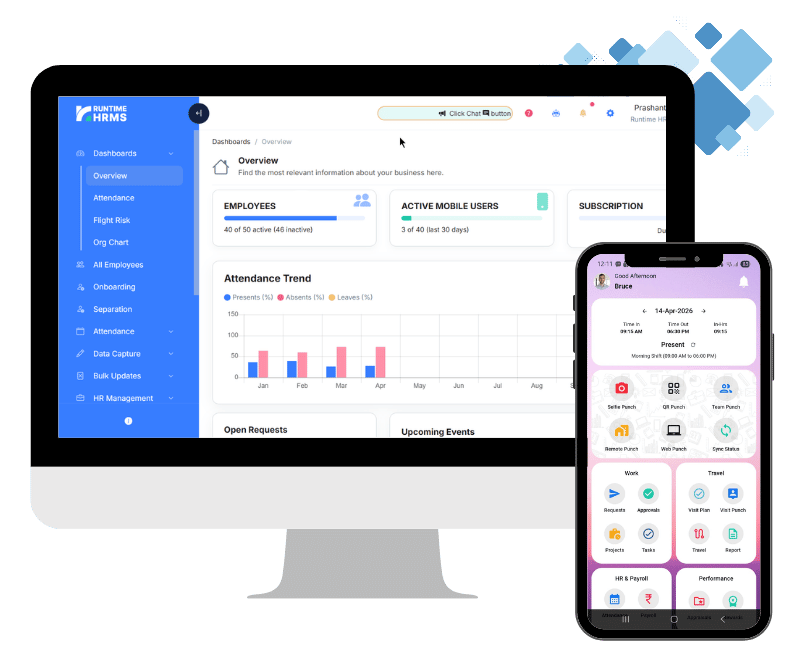
HRMS system like Runtime HRMS, Keka, Zoho etc
Payroll software India
Attendance tools
Data backup systems
These tools require additional money and IT support.
Outsourced Payroll Technology Benefits
Vendors provide:
Mobile-friendly hrms payroll
Real-time dashboards
Employee self-service portals
Automated calculations
Online attendance integration
Bank transfer integrations
Encrypted data storage
With online employee management integrated into payroll, companies reduce errors and improve operational efficiency.
10. Which Option Fits Different Indian Businesses?
Startups (1–50 employees)
Recommended: Outsourced Payroll
Low cost + no compliance burden.
MSMEs (50–200 employees)
Recommended: Outsourcing or Hybrid
Affordable and scalable.
Mid-size businesses (200–1000 employees)
Recommended: Hybrid Payroll
Use internal HR with vendor support and advanced hr and payroll software.
Large enterprises (1000+ employees)
Recommended: In-House or Hybrid
Large teams prefer internal control supported by robust employee payroll management systems.
Pan-India multi-state companies
Recommended: Outsourcing
Due to complex state-by-state regulations.
11. Hybrid Payroll: A Balanced Approach
Hybrid payroll combines internal HR operations with outsourced processing.
Example workflow:
HR handles employee data in the HRMS system
Outsourcing partner processes payroll
HR verifies final output
Vendor handles compliance filings
This gives companies control, accuracy, and reduced workload.
12. In-House Payroll vs Outsourced Payroll
| Feature | In-House Payroll | Outsourced Payroll |
|---|---|---|
| Cost | High | Low |
| Compliance | Complex | Expert-managed |
| Control | Full | Limited |
| Technology | Requires investment in payroll software India | Vendor provides cloud based payroll software India |
| Customization | High | Moderate |
| HR Workload | Heavy | Minimal |
| Data Security | Internal responsibility | Vendor-managed security |
| Scalability | Slow | Fast |
| Automation | Depends on hrms system | Included with hrms payroll tools |
13. Conclusion: Which One Should You Choose?
Both in-house and outsourced payroll have strong advantages. The right choice depends on your business size, compliance needs, and budget.
Choose Outsourced Payroll If You Want:
Cost savings
Automatic compliance
Less HR workload
Advanced online payroll management software
Integrated online employee management
Choose In-House Payroll If You Need:
Maximum control
Deep customization
Strong internal HR capacity
High-budget, enterprise-level HRMS infrastructure
Best for Most Indian Companies Today: Hybrid
A hybrid approach supported by modern hr and payroll software or payroll software India gives businesses the flexibility and accuracy they need while saving time and reducing risk.