
Introduction
New tax regime vs old tax regime India 2026 — this is the question every HR manager faces every April.
And honestly? It’s not a simple yes or no. It depends on the employee’s salary, their investments, their home loan, their HRA, many other components. But did you know what changes in year 2026? The new Income Tax Act 2025 came into effect from 1st April 2026, replacing the old Income Tax Act 1961. The new tax regime has become even more attractive for most salaried employees. So, let’s break this down clearly and new tax regime vs old tax regime India 2026
No jargon, no CA-level complexity. Just a simple, honest comparison so you — the HR manager — can guide your employees correctly.
What Actually Changed in FY 2026-27?
Before we compare, let’s quickly understand what’s new this year.
Under the new tax regime for FY 2026-27:
- Basic exemption limit increased from ₹3 lakh to ₹4 lakh
- Standard deduction is ₹75,000 for all salaried employees
- Section 87A rebate of ₹60,000 — making income up to ₹12 lakh effectively zero tax
- For salaried employees specifically — gross salary up to ₹12.75 lakh is tax-free (₹12 lakh + ₹75,000 standard deduction)
- A new 25% tax bracket has been added between the 20% and 30% slabs
- The new regime is now the default regime — employees have to actively opt out if they want the old regime
And the old regime? No changes. Same slabs, same deductions, same structure as before.
The Tax Slabs
New Tax Regime — FY 2026-27
| Income Slab | Tax Rate |
| Up to ₹4,00,000 | Nil |
| ₹4,00,001 – ₹8,00,000 | 5% |
| ₹8,00,001 – ₹12,00,000 | 10% |
| ₹12,00,001 – ₹16,00,000 | 15% |
| ₹16,00,001 – ₹20,00,000 | 20% |
| ₹20,00,001 – ₹24,00,000 | 25% |
| Above ₹24,00,000 | 30% |
Plus: Standard deduction of ₹75,000 for salaried employees. Plus: Section 87A rebate up to ₹60,000 for taxable income up to ₹12 lakh.
Old Tax Regime — FY 2026-27
| Income Slab | Tax Rate |
| Up to ₹2,50,000 | Nil |
| ₹2,50,001 – ₹5,00,000 | 5% |
| ₹5,00,001 – ₹10,00,000 | 20% |
| Above ₹10,00,000 | 30% |
Plus: All deductions and exemptions — 80C, 80D, HRA, LTA, home loan interest, NPS, etc. Note: 4% Health and Education Cess apply on tax in both regimes.
As per the Income Tax Department India, the new tax regime is the default regime for all salaried individuals from FY 2024-25 onwards.
Who Benefits from Which Regime?
When employees ask about new tax regime vs old tax regime India 2026, the answer depends on one simple factor — their total deductions.
New regime – is better if the employee’s total deductions and exemptions are less than ₹3.75 lakh per year.
Old regime – is better if the employee has significant investments — home loan, 80C investments, HRA, NPS — and their deductions cross ₹3.75 lakh. Let me show you this with real examples.
Here are some real examples, so your employees can decide.
Example 1
Salary ₹8 Lakh per Year (No Major Investments)
Meet Naina. She earns ₹8 lakh per year. She has basic 80C investments of ₹50,000 but no home loan and no HRA.
Under the New Regime:
- Gross salary: ₹8,00,000
- Less standard deduction: ₹75,000
- Taxable income: ₹7,25,000
- Tax on ₹7,25,000: ₹16,250 (5% on ₹3,25,000 above ₹4 lakh)
- 4% cess: ₹650
- Total tax: ₹16,900
Under Old Regime:
- Gross salary: ₹8,00,000
- Less standard deduction: ₹50,000
- Less 80C: ₹50,000
- Taxable income: ₹7,00,000
- Tax: ₹25,000 + 20% on ₹2,00,000 = ₹65,000
- 4% cess: ₹2,600
- Total tax: ₹67,600
New regime saves Naina ₹50,700 per year.
Example 2
Salary ₹15 Lakh per Year (With Investments and Home Loan)
Meet Mohit. He earns ₹15 lakh per year. He has a home loan with ₹2 lakh interest deduction, 80C investments of ₹1.5 lakh, HRA exemption of ₹1.2 lakh, and NPS of ₹50,000.
Total deductions = ₹2,00,000 + ₹1,50,000 + ₹1,20,000 + ₹50,000 = ₹5,20,000
Under New Regime:
- Taxable income: ₹15,00,000 – ₹75,000 = ₹14,25,000
- Tax: approximately ₹1,48,750
- 4% cess: ₹5,950
- Total tax: ₹1,54,700
Under Old Regime:
- Taxable income: ₹15,00,000 – ₹50,000 (SD) – ₹5,20,000 (deductions) = ₹9,30,000
- Tax: ₹1,12,500 + 20% on ₹4,30,000 = ₹1,98,500
- Wait — that’s higher. Let me recalculate correctly.
- Tax: ₹12,500 (5% on ₹2.5L) + ₹1,00,000 (20% on ₹5L) = ₹1,12,500 + 20% on ₹4,30,000 = ₹86,000 = ₹1,12,500…
Mohit with these deductions:
- Taxable income under old regime: ₹9,30,000
- Tax: ₹12,500 + ₹86,000 = ₹98,500
- 4% cess: ₹3,940
- Total tax: ₹1,02,440
Old regime saves Mohit ₹52,260 per year — because his deductions are high.
Example 3
Salary ₹12.75 Lakh (The Sweet Spot)
Meet Anita. She earns exactly ₹12.75 lakh per year with minimal investments.
Under New Regime:
- Gross: ₹12,75,000
- Less standard deduction: ₹75,000
- Taxable income: ₹12,00,000
- Section 87A rebate applies — tax liability = ZERO
Yes. Zero tax. This is the most talked-about benefit of the new regime in 2026.
Under Old Regime:
- Even with good investments, she would pay some tax at this income level.
New regime is clearly better for Anita.
The Simple Rule for HR Managers
When employees ask you which regime to choose, give them this simple framework:
Step 1: Add up their all deductions — 80C, 80D, HRA, home loan interest, LTA, NPS, standard deduction.
Step 2: If the total deductions are less than ₹3.75 lakh → Then new regime is better.
Step 3: If the total deductions are more than ₹3.75 lakh → Then old regime may be better. Ask them to calculate both.
Step 4: If you still in doubt, use an online tax calculator or ask a CA.
Just keep in mind — this is a general rule. Every employee’s situation is slightly different.
Which Regime is Default in 2026?
This is important for HR managers to know.
New tax regime is the default. If an employee does not submit their tax regime declaration — your payroll system will automatically deduct TDS under the new regime. If an employee wants the old regime, they must actively declare it — usually through Form 10-IE or through their employer’s investment declaration process at the start of the financial year.
And here is the good news for salaried employees — they can switch between old and new regime every financial year. Unlike business owners who can only switch once, salaried employees have the flexibility to choose whichever regime is better for them each year.
What Should HR Managers Do Right Now?
If you haven’t already done this for FY 2026-27 — do it now:
1. Collect tax regime declarations from all employees:
Send a formal communication and ask every employee to declare their preferred tax regime for FY 2026-27. Give them a deadline, ideally by end of April.
2. Process TDS based on declared regime
Once you have declarations, configure your payroll accordingly. Employees who haven’t declared will default to new regime.
3. Remind employees about investment declarations
If the employees is choosing the old regime, they need to submit their investment proofs and declarations like home loan certificate, 80C investments, HRA details, so that you can calculate their TDS correctly.
4. Mid-year review in January
In January, remind employees to review their actual investments vs declarations. If they over-declared, TDS will be short and they’ll face a big deduction in February-March. Prevention is better than last-minute panic.
Believe me — this one step of timely collection of declarations saves enormous back-and-forth between HR and employees in the last quarter of the financial year.
Tax regime declaration also plays an important role during Full and Final Settlement. Read our complete FnF Settlement Guide to make sure nothing is missed during employee exit.
Old Regime Deductions
For employees who choose the old regime, here are the key deductions they can claim:
| Deduction | Section | Limit |
| PPF, ELSS, Life Insurance, EPF, Home Loan Principal | 80C | ₹1,50,000 |
| Health Insurance Premium | 80D | ₹25,000 (₹50,000 for senior citizens) |
| Home Loan Interest | Section 24(b) | ₹2,00,000 (self-occupied) |
| NPS Contribution | 80CCD(1B) | ₹50,000 additional |
| HRA Exemption | Section 10(13A) | Based on actual rent and salary formula |
| LTA | Section 10(5) | Actual travel cost — twice in 4 years |
| Standard Deduction | — | ₹50,000 |
New Tax Regime vs Old Tax Regime India 2026
New regime: Lower tax rates, no deductions needed, zero tax up to ₹12.75 lakh for salaried employees, default regime, simple and easy.
Old regime: Higher rates but big deductions available — best for employees with home loans, large 80C investments, HRA, and NPS. Requires more paperwork and planning.
How Runtime HRMS Handle This Smoothly
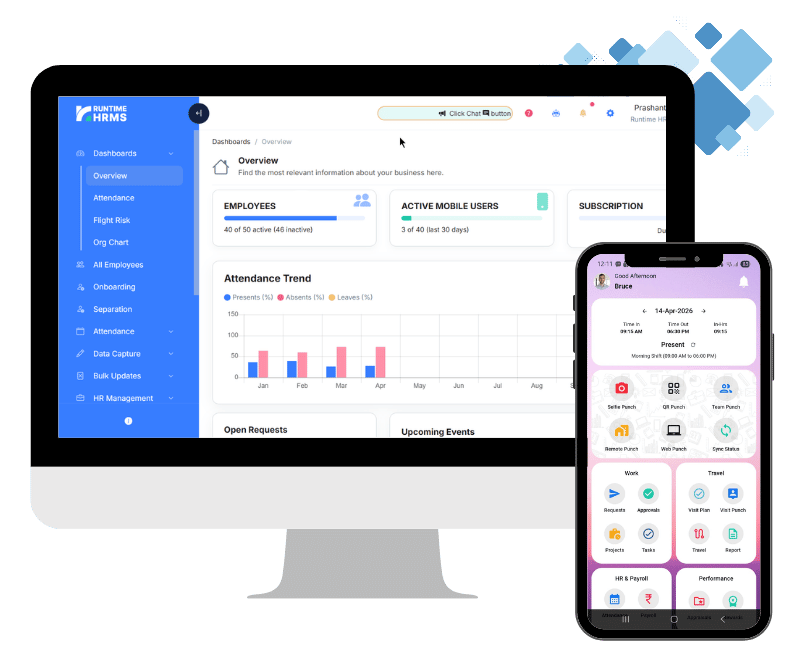
It’s totally understandable that managing two tax regimes for 50, 100, 200 employees manually is a nightmare. Because there are different declarations, different TDS calculations, different investment proofs and it gets complicated fast. But Runtime HRMS handles both regimes automatically.
No spreadsheet juggling. No regime confusion. No last-minute TDS correction panic.
👉 Book a Free Demo — See How Runtime HRMS Handles Tax Regimes →
For Runtime HRMS users — Learn how to configure tax regime settings here.
Summary
We all know that understanding new tax regime vs old tax regime India 2026 is one of the most important things for the HR managers, they need to get right at the start of every financial year.