
If you are reading this article, that means you are struggling with payroll and compliance and searching for the best option available in market of Payroll & HRMS software. That not only fulfil you business requirements but also cost saving.
See, there are many Payroll & HRMS software available, all are good and well-established, but it’s not compulsory that they are all good for your company. Now the question is how you can select the best for your company.
So, before you sign anything, before you even shortlist, here are the seven questions every business owner and HR manager in India should answer. These apply regardless of which software you’re evaluating.
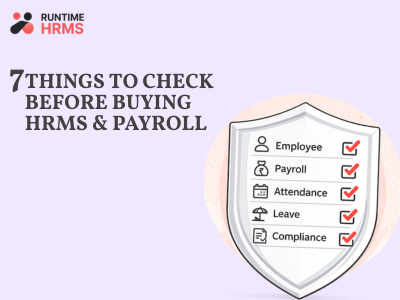
7 Things Every Business Must Check Before Buying Payroll Software in India
1. Is Payroll Actually Included — Or Is It an Add-On?
This is the question that most HR and business actually got confused.
Many HR platforms in India advertise an attractive base price — and hide the fact that payroll processing is a separate product with separate pricing. You sign up, configure everything, and then realise that running actual salaries requires an upgrade or an integration you didn’t budget for.
Before you compare prices, confirm exactly what the number you’re seeing includes. Does it cover payroll calculation? PF and ESI deductions? TDS? Form 130 generation? Or is each of these a separate line item?
2. Does Attendance Come with the Plan You’re Buying?
Attendance management is the most important part of any organization, is not a premium feature. Every business with employees needs it from Day 1.
And you will be surprised that – several major HRMS platforms in India, offers attendance management in higher-tier plans. The entry plan looks affordable, you sign up, and then you realise that attendance tracking — the thing your HR team needs every single day — requires an upgrade.
Ask specifically: is mobile attendance, geo-tagging, and biometric integration available in the plan I’m considering? Or do I need to move up a tier to access it?
If attendance isn’t included in the base plan, factor in the real cost of the plan that does include it. That’s the number you should be comparing.
3. Is there Free Trial Available?
This is the most important point you should keep in mind, because this gives you time to evaluate and examine the Payroll & HRMS software. To properly evaluate payroll software, you need to:
- Configure your salary structures
- Import your employee data
- Process one complete payroll cycle
- Verify PF, ESI, and TDS calculations against your existing numbers
Also check: does the trial require a credit card? A vendor who asks for payment details before you’ve validated the product is putting their revenue ahead of your confidence. That’s a signal worth noting.
4. What About the Support During Payroll Week?
This is the question nobody asks in the demo — and everyone wishes they had.
Payroll doesn’t wait. When you’re trying to close salary by the 1st and something isn’t calculating correctly, you need help within the hour — not within 48 hours. And yet, many HRMS platforms in India tier their support: email only on the base plan, chat on the middle plan, phone support only on the most expensive tier.
Ask the vendor directly: what support channels are available on the plan I’m buying? What is the average response time? Is there live chat during Indian business hours? Can I speak to someone on the phone if I have an urgent payroll issue?
If the answer is “we’ll get back to you in 2 business days” — understand what that means when your payroll deadline is tomorrow.
5. What Does Your Cost Look Like as You Grow?
Some platforms have low entry pricing that jumps significantly at 50, 100, or 200 employees. Some have minimum billing thresholds — you have 30 employees but pay for 50. Some lock you into annual contracts at the current rate and then increase pricing at renewal.
Before you commit, map out what your cost looks like at your current headcount, at 1.5× your current headcount, and at 2×. Ask the vendor directly: what happens to my pricing when I cross X employees? Is there a minimum billing threshold? What is your pricing change policy at renewal?
6 How Does the Software Handle Compliance Updates?
India’s labour compliance changed dramatically in 2025 and 2026 — new Labour Codes, EPF Scheme 2026, Income Tax Act 2025 replacing the 1961 Act, new form numbers (Form 16 is now Form 130, Form 24Q is now Form 143), new section references for TDS.
Every time the government notifies a change, your payroll software needs to reflect it. The question is: does it happen automatically, or does it require you to manually update something?
Ask the vendor: when new compliance rules are notified, how quickly does the software update? Do I need to do anything, or does it happen automatically? Who is responsible if my payroll runs non-compliant because the software wasn’t updated in time?
Check also with: EPFO →
7. Will Your Employees Actually Use It?
This is the question that gets skipped most often — and it determines whether the software succeeds or fails in practice.
The best HRMS in the world is worth nothing if your employees don’t use it. An app that requires remembering a login, navigating 5 screens, and downloading a PDF to find a payslip will be abandoned. Employees will go back to asking HR on WhatsApp. Which means HR goes back to answering the same questions 20 times a month. Which means the whole point of the software disappears.
Before you choose, think honestly about your workforce. Are they tech-comfortable? Do they use smartphones regularly? What apps do they already use every day?
If your employees are on WhatsApp all day — and in India, they almost certainly are — a platform that sends payslip notifications, leave approval updates, and salary alerts via WhatsApp will get used. A platform that requires them to log into a separate portal won’t.
Employee adoption is not a nice-to-have. It is the measure of whether you got value from the software or just paid for something nobody uses.
The Right HRMS Saves You More Than It Costs
A good payroll and HRMS platform saves the average HR manager 10–15 hours every month. It eliminates compliance errors that can cost 5–10× the software price in penalties. It gives employees visibility into their own information — reducing HR queries, improving satisfaction, and building trust.
But only if you choose the right one.
Take these seven questions into every demo you attend, every trial you start, every pricing conversation you have. They’ll cut through the marketing and help you see what you’re getting.
And if you want a platform that answers all seven questions well – 👉 Book a Free Demo →
Also Read: