

Running Payroll every month is not an easy task for any HR in India, it not about how many times an HR has done this process, it is about how efficiently its done. Attendance data, leave records, new joiners, resignations, and investment declarations – something always seems to be missing or wrong.
This all not because HR manager was careless. But because there was no system. No checklist. There should be a process before processing a payroll, so that mistakes and delays can avoid. In this article I have explained 7 points that every HR and business must follow before hit the payroll every month.
Here’s the checklist I recommend to every HR manager I work with.
1. Is Attendance Data Complete and Finalized?
Before you run payroll, every single employee’s attendance for the month must be finalized. Not mostly finalized. Not “I’ll sort out the last few later.” Completely finalized.
Check for: employees who forgot to mark attendance on specific days, regularization requests that are still pending with managers, field employees whose GPS data hasn’t synced, and any shift changes that weren’t captured in the system. Running payroll on incomplete attendance data means your LOP deductions will be wrong – which means salaries will be wrong – which means employees will be calling you the moment their pay slip hits their phone.
Finalize attendance first. Then move to everything else.
2. Have All Leaves Been Approved or Rejected?
This is the second most important point, you must check with managers for pending leave approval, if any. Before payroll, send a reminder to all managers: any pending leave requests must be actioned before the payroll cutoff date.
Make this a policy, not a request. Payroll cannot be held up because someone forgot to click approve.
3. Are New Joiners Fully Set Up in the System?
New joiners are one of the most common sources of payroll errors – and the errors are usually completely avoidable. For every employee who joined during the month, verify: salary structure is configured correctly, PF and ESI applicability is set, bank account details are entered and verified, PAN and Aadhaar are linked, tax regime declaration has been submitted, and the joining date is accurate for pro-rata calculation.
4. Have All Resignations and Exits Been Updated?
Before running a payroll check your exit list for the month. For every employee who resigned or was terminated, confirm their last working day is updated in the system, their FnF calculation is initiated, any notice period recovery or leave encashment is captured, and their salary is being processed only for the days they actually worked.
Also check: did anyone leave mid-month whose salary was already processed last month but shouldn’t have been this month?
5. Are Salary Revisions, Bonuses, and Arrears Captured?
Increments, performance bonus, arrears from a delayed revision and advance salary recoveries these are crucial part of payroll. All of these need to be in the system before you run payroll- not added manually after the fact on individual payslips.
I always ask HR managers to maintain a simple change log during the month – a running note of every salary-related change that needs to be reflected in the next payroll. Reviewing this log the day before payroll closing catches the things that would otherwise be missed.
6. Have Investment Declarations Been Submitted and TDS Recalculated?
This matters most in the second half of the financial year – October through March – when employees are supposed to have their investment proofs in order.
If an employee declared ₹1.5 lakh in 80C investments in April but hasn’t submitted actual proofs and is now in January – your TDS calculation from April is wrong. The difference needs to be recovered in the remaining months. Waiting until February and March to fix this creates a massive TDS spike in the employee’s last two payslips – which leads to complaints, confusion, and sometimes accusations that payroll got it wrong.
Before payroll each month in Q3 and Q4 – check who has pending investment proof submissions. Chase them. Recalculate TDS for those employees before processing. Spread the correction early rather than dumping it all at the end.
Check latest rules: Income Tax India →
7. Run a Pre-Payroll Validation
Before you hit the final process button – run your payroll in preview mode and compare the output with the previous month.
Look for: salaries that are significantly higher or lower than last month without a clear reason, employees whose PF or ESI deduction changed unexpectedly, anyone whose net pay dropped below a threshold that doesn’t make sense, and any employee who appears in this month’s run but shouldn’t.
Most payroll software – including Runtime HRMS – generates a variance report that flags these differences automatically. If yours doesn’t, build this comparison manually in a spreadsheet before every payroll run. This one check – spending 15 minutes comparing this month to last month – catches 80% of errors before they become employee complaints.
The Real Cost of Skipping Payroll Checklist
Every payroll error creates at least three problems. The correction itself – recalculating, reprocessing, reissuing payslips. The employee communication – explaining what went wrong and when it will be fixed. And the trust damage – because employees notice when their salary is wrong, and they remember it for a long time.
One wrong payroll doesn’t just create a complaint. It creates doubt. “Is this company reliable?” That doubt affects retention, morale, and how employees talk about the company to their networks. The seven checks above take 30–45 minutes before every payroll run. They prevent problems that take days to fix and weeks for employees to forget.
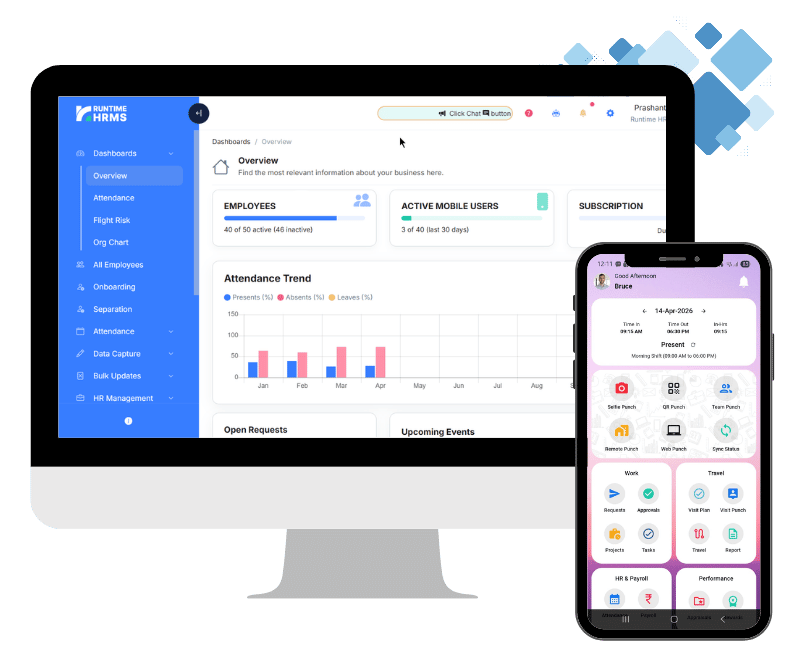
At Runtime HRMS, these checks are built into the payroll workflow. The system flags incomplete attendance, pending leave approvals, missing employee details, and salary variances before you reach the process button. You review, you approve, you run. No surprises.
Quick Summary – Your Pre-Payroll Checklist
- ✅ Attendance finalized for all employees
- ✅ All leave requests approved or rejected
- ✅ New joiners fully set up – salary, PF, ESI, bank, PAN
- ✅ Exits updated – last working day, FnF initiated
- ✅ Salary revisions, bonuses, arrears captured
- ✅ Investment declarations updated, TDS recalculated
- ✅ Pre-payroll variance check vs last month
Must Read
7 Things to Check Before Buying Payroll & HRMS Software in India
Top 10 Payroll Software in India for Small Businesses (2026 Guide)