

“What exactly is gross salary? Is it the same as CTC? This is the first most common question comes in new HR manager’s mind. And honestly, I understand the confusion. In India, salary has so many layers — CTC, gross, net, take-home, in-hand — that even experienced professionals sometimes mix them up. And when HR mixes them up, employees get confused, disputes happen.
So let me clear this up once and for all. In this article, I’m going to explain exactly what gross salary is, how to calculate it, what goes into it, what doesn’t, and walk you through real examples.
What is Gross Salary Actually Means?
Gross salary is the total amount an employee earns in a month before any deductions are made. That means before PF is cut. Before TDS is deducted. Before Professional Tax. Before anything. Think of it this way — gross salary is every rupee the employee earns that month, before anyone takes a cut. Basic salary, HRA, allowances, overtime if any — all of it goes in. What stays out is the employer’s own contributions like PF and ESI — those are the company’s cost, not the employee’s earning.
The simple formula:
Gross Salary = Basic Salary + HRA + All Allowances + Variable Pay (if any)
How Gross Salary Relates to CTC and Net Salary
Before we go further, let’s first look at:
- CTC (Cost to Company): CTC is everything the company spends on you in a year. Not just your salary — but also the employer’s PF, ESI, gratuity provision, insurance, and anything else the company puts in on your behalf.
- Gross Salary: It sits inside CTC. This is what employee earns — not what the employer spends.
- Net Salary (Take Home): Net salary is what finally lands in your bank account — after PF, TDS, Professional Tax, and everything else has been cut.
So the relationship is:
CTC > Gross Salary > Net Salary
When a candidate asks, “what will I get in hand?” — they’re asking for net salary.
Components of Gross Salary in India
Let me walk you through what typically makes up gross salary in an Indian company. Every company structures it slightly differently — but these are the standard components.
Basic Salary
This is the foundation. Everything else is calculated around it — PF is a percentage of basic, HRA is typically a percentage of basic, gratuity is based on basic. Under the Labour Codes effective November 2025, basic salary plus DA must be at least 50% of total CTC. So if you’re offering a ₹6 lakh CTC, basic + DA must be at least ₹3 lakh annually — or ₹25,000 per month.
Basic salary is fully taxable under both old and new tax regimes.
HRA — House Rent Allowance
HRA is given to cover the employee’s rental expenses. Typically it’s 40% to 50% of basic salary — 40% for non-metro cities, 50% for metros like Mumbai, Delhi, Bengaluru, Chennai, Hyderabad, and Kolkata.
Under the old tax regime, HRA can be partially or fully exempt from tax if the employee actually pays rent. Under the new tax regime (which is the default from FY 2026-27), HRA exemption is not available — it’s fully taxable.
Conveyance / Transport Allowance
Given for commuting expenses. Standard amount is ₹1,600 per month in most companies — though there’s no statutory requirement. Under the old regime, up to ₹1,600/month was tax exempt. Under the new regime, it’s fully taxable.
Special Allowance
This is the balancing component — whatever remains after Basic, HRA, and other fixed allowances. It’s fully taxable under both regimes. Many companies use this to fill up the difference between gross and the sum of other components.
Medical Allowance
Some companies include a fixed monthly medical allowance — typically ₹1,250 per month. Under the old regime, up to ₹15,000 annually was exempt with bills. Under the new regime, fully taxable.
Leave Travel Allowance (LTA)
Provided for travel expenses. Under the old regime, actual travel costs are exempt twice in a 4-year block. Under the new regime, not available.
Performance Bonus / Incentives (Variable)
If an employee gets a monthly incentive or variable pay — it becomes part of gross salary for that month. Annual bonuses are typically shown separately in CTC but may be included in gross if paid monthly.
Overtime Pay
If your company pays overtime — it gets added to gross salary for that month.
What Is NOT Included in Gross Salary
Just as important as what’s in it — is what’s not.
- Employer PF contribution — This is part of CTC, not gross salary. The employer’s 12% PF contribution is a cost to the company — it does not appear on the employee’s gross.
- Employer ESI contribution — Same logic. The employer’s 3.25% ESI contribution is a cost — not part of gross.
- Gratuity provision — Monthly gratuity provision is part of CTC. Not gross salary.
- Reimbursements — Fuel bills, mobile bills, expense claims — these are reimbursements, not salary components. They typically don’t form part of gross salary.
- Medical Insurance premium — If the company pays for group health insurance, that cost is part of CTC but not gross salary.
The Gross Salary Formula
Gross Salary = Basic + HRA + Conveyance + Special Allowance + Medical Allowance + LTA + Any Other Allowances + Variable Pay (if applicable that month)
3 Practical Examples
Example 1 — Junior Employee, Non-Metro City
Riya works as an HR Executive in Jaipur. Her salary structure:
| Component | Monthly Amount |
| Basic Salary | ₹18,000 |
| HRA (40% of Basic) | ₹7,200 |
| Conveyance | ₹1,600 |
| Special Allowance | ₹3,200 |
| Gross Salary | ₹30,000 |
Example 2 — Mid-Level Employee, Metro City
Arjun is a Sales Manager in Mumbai. His salary structure:
| Component | Monthly Amount |
| Basic Salary | ₹35,000 |
| HRA (50% of Basic — Metro) | ₹17,500 |
| Conveyance | ₹1,600 |
| Medical Allowance | ₹1,250 |
| Special Allowance | ₹9,650 |
| Gross Salary | ₹65,000 |
Example 3 — Senior Employee with Variable Pay
Deepa is a Product Head in Bengaluru. She has a fixed component and a monthly performance incentive.
| Component | Monthly Amount |
| Basic Salary | ₹60,000 |
| HRA (50% of Basic) | ₹30,000 |
| Special Allowance | ₹15,000 |
| LTA (monthly provision) | ₹5,000 |
| Performance Incentive (variable) | ₹10,000 |
| Gross Salary | ₹1,20,000 |
How to Calculate Gross Salary From CTC
This is something HR managers need to do frequently — when a candidate asks “what will my gross be if CTC is X?”
Here’s how to work it out:
Step 1 — Identify employer contributions that sit outside gross:
- Employer PF = 12% of Basic
- Employer ESI = 3.25% of Gross (if applicable)
- Gratuity provision = 4.81% of Basic (approximately)
Step 2 — Subtract those from annual CTC to get annual gross
Step 3 — Divide by 12 for monthly gross
Example:
- CTC = ₹6,00,000 per annum Basic = ₹25,000/month (₹3,00,000 annual — 50% of CTC as per Labour Codes)
- Employer PF = 12% × ₹3,00,000 = ₹36,000 Gratuity provision = 4.81% × ₹3,00,000 = ₹14,430
- Annual Gross = ₹6,00,000 − ₹36,000 − ₹14,430 = ₹5,49,570 Monthly Gross = ₹5,49,570 ÷ 12 = ₹45,797
- So for a ₹6 lakh CTC, the employee’s gross salary is approximately ₹45,800 per month — not ₹50,000.
This gap is what surprises most new joiners. And it’s what causes trust issues if HR doesn’t explain it clearly during the offer stage.
Check latest update with: EPFO →
The 50% Basic Rule and Its Impact on Gross Salary
Something that changed significantly post November 2025 — and directly impacts how you structure gross salary. Under the Labour Codes, Basic + DA must be at least 50% of CTC. Previously, many companies kept basic low — say 30-35% of CTC — to reduce PF and gratuity outgo, since both are calculated on basic.
Now, if basic is below 50% of CTC, the government treats the excess allowances as wages — which means PF and gratuity get calculated on a higher base anyway. The tax optimization that companies tried to achieve by keeping basic low essentially doesn’t work anymore. This means gross salary structures need to be revisited. If you haven’t done this at your company yet — it’s time. I’d recommend reviewing every existing employee’s salary structure against the 50% rule and updating offer letter templates for new hires.
How Runtime HRMS Handles This
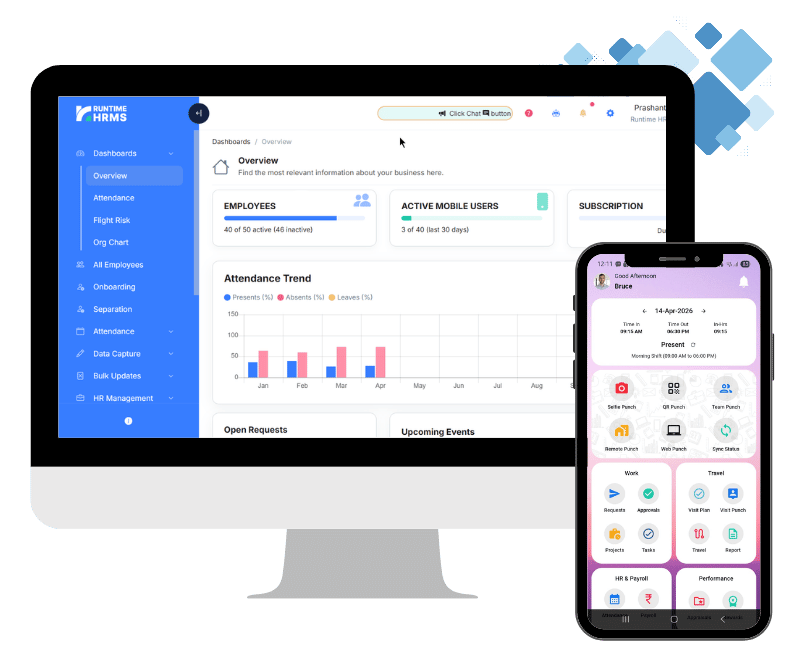
When we built Runtime HRMS, one of the things we were most particular about was salary structure configuration. Because if the structure is wrong, every downstream calculation — PF, ESI, TDS, net pay — is wrong too.
In Runtime HRMS, you configure each employee’s salary structure once — with the correct components, correct percentages, and correct wage classification. From that point, every month’s gross salary, deductions, and net pay are calculated automatically. If the employee’s salary changes, you update it once and everything recalculates.
No formula errors. No wrong PF base. No mid-month joiner getting the wrong prorated amount.
👉 Book a Free Demo — See How Runtime HRMS Structures Salaries →
Quick Summary
- Gross Salary = Basic + HRA + All Allowances + Variable Pay
- Gross salary does NOT include employer PF, employer ESI, or gratuity provision
- CTC > Gross Salary > Net Salary — all three are different
- Basic + DA must be minimum 50% of CTC under Labour Codes 2025
- For mid-month joiners: Prorated Gross = Monthly Gross ÷ 26 × Days Worked
- Always explain the CTC vs gross difference to candidates at the offer stage
Frequently Asked Questions
What is the difference between gross salary and CTC?
Think of it this way — CTC is everything the company spends on you in a year. Your salary, yes. But also the employer’s PF, ESI, gratuity provision, insurance — all of it. Gross salary is just your earning part. CTC is the company’s total outgo. The two are never the same number, and that gap is what surprises most new joiners on their first payslip.
How is HRA calculated in gross salary?
Most companies follow a simple thumb rule — 40% of basic for non-metro cities, 50% for metros like Mumbai, Delhi, Bengaluru. But honestly, there’s no law forcing this. Every company sets it based on their own policy. Some pay flat amounts; some pay higher percentages. What matters for tax purposes is how much rent the employee actually pays — that determines the exemption under the old regime.
How do I calculate gross salary for a new joiner who joined mid-month?
Divide the monthly gross by 26 — that gives you the per day rate. Then multiply by the number of days they actually worked that month. Most companies stick to 26 as the standard, regardless of how many actual working days that particular month has. It keeps things consistent and avoids arguments about whether a specific month had 4 or 5 Sundays.