

Quick Answer: How is Gratuity Calculated in India?
For employees covered under the applicable gratuity provisions, gratuity is generally calculated as:
Gratuity = Last Drawn Wages × 15 ÷ 26 × Completed Years of Service
Service Rule = A part of a year exceeding 6 months is generally counted as 1 completed year
For every completed year of service-or part of a year exceeding six months -15 days’ wages are considered. Eligibility and the wage base can vary depending on the employee category and rules applicable after the Labour Codes took effect on 21 November 2025.
Gratuity calculation looks simple on paper. But between the rounding rules, the salary base question, the ₹20 lakh cap, and the new Labour Code changes, it trips up HR teams far more often than it should. I’ve seen companies overpay because they used gross salary instead of basic. I’ve seen companies underpay because they forgot to round up the service period. Both create problems – one legal, one with the employee.
So let me walk you through this properly. Formula, examples, common mistakes. We’ve built a free Gratuity Calculator that does all of this for you – enter your Basic Salary, Years of Service, and additional months, and get your gratuity amount instantly.
Who is Eligible for Gratuity?
Before calculating, you need to confirm eligibility.
Under India’s current gratuity framework, eligibility depends on the applicable provisions of the Code on Social Security, 2020 and related rules/guidance. For most regular employees, five years of continuous service remains the standard eligibility threshold, subject to statutory exceptions.
There’s one important nuance I always flag for HR teams: if an employee has completed 4 years and 240 working days in their fifth year, most courts treat that as 5 complete years. So before you reject a gratuity claim because someone left at 4 years and 9 months, count the actual working days in that fifth year. The difference can be significant.
Gratuity Calculation New rule from November 2025:
One more thing worth flagging – especially if you hire on fixed-term contracts. Under the new Labour Codes effective November 21, 2025, fixed-term employees no longer need to wait 5 years for gratuity. After just 1 year of service, they become eligible for pro-rata gratuity. If your company relies heavily on contract hires, this changes your gratuity liability significantly.
The Gratuity Calculation Formula
For companies covered under the Payment of Gratuity Act – which is most companies with 10+ employees:
Gratuity = (Last Drawn Basic + DA) × 15 × Years of Service ÷ 26
In simple terms:
- Last Drawn Salary = Basic Salary + Dearness Allowance (DA)
- 15 = 15 days’ salary for every completed year
- 26 = Number of working days considered in a month
- Years of Service = Total completed years
Let me break down what each part means.
Last Drawn Basic + DA – This is the salary base for gratuity. Not gross salary. Not CTC. Only Basic Salary plus Dearness Allowance. This is where most errors happen. If someone’s gross is ₹60,000 but their Basic is ₹30,000, gratuity is calculated on ₹30,000.
15 – Represents 15 days of wages per completed year of service.
26 – The number of working days assumed in a month (excluding Sundays).
Years of Service – Completed years, with the rounding rule: if the last year has more than 6 months, round up to the next full year. Less than or equal to 6 months, round down.
For companies not covered under the Act (fewer than 10 employees, though many still pay voluntarily):
Gratuity = (Last Drawn Basic + DA) × 15 × Years of Service ÷ 30
This uses 30 as the divisor instead of 26 – which results in a lower gratuity amount.
Gratuity Calculations Example
Example 1 – Standard case
Ramesh worked at a manufacturing company for 8 years and 4 months. His last drawn Basic Salary was ₹35,000. No DA.
Service period rounding: 8 years 4 months – less than 6 months in the last year, so count as 8 years.
Gratuity = ₹35,000 × 15 × 8 ÷ 26 = ₹1,61,538
Example 2 – With rounding up
Sunita worked for 6 years and 9 months. Last drawn Basic + DA = ₹45,000.
Service period: 6 years 9 months – more than 6 months in the last year, round up to 7 years.
Gratuity = ₹45,000 × 15 × 7 ÷ 26 = ₹1,82,692
Had we not rounded up, she’d have gotten ₹1,56,923. That’s a difference of ₹25,769 – which is material for the employee and a compliance risk for the company.
Example 3 – High earner approaching the cap
Vikram served 25 years. Last drawn Basic = ₹80,000.
Formula gives: ₹80,000 × 15 × 25 ÷ 26 = ₹11,53,846
This is below the ₹20 lakh cap, so full amount is payable.
If Vikram’s Basic were ₹1,50,000 and service 30 years: ₹1,50,000 × 15 × 30 ÷ 26 = ₹25,96,153 – exceeds ₹20 lakh cap. Pay ₹20 lakh.
Is Gratuity Tax-Free?
The tax treatment of gratuity depends on the employee’s category and the applicable provisions of Section 10(10) of the Income Tax Act. For many non-government employee categories, the exemption is subject to a ₹20 lakh ceiling, while different rules can apply to government employees.
Government employees enjoy a full exemption – no upper limit. The entire gratuity is tax-free regardless of the amount. In case of death, gratuity paid to the nominee or legal heir is fully exempt with no ceiling.
Payment Timeline
Gratuity must be paid within 30 days of the date it becomes payable. Delay attracts interest at 10% per annum for every year of delay. That’s a real cost – and it compounds. Make sure your FnF process includes gratuity calculation on Day 1, not as an afterthought after the employee has already left.
How Runtime HRMS Handles Gratuity Calculation
This is exactly the kind of calculation that looks simple but quietly goes wrong when done manually. Wrong salary base, missed rounding, overlooked fixed-term staff – each one is a potential compliance issue.
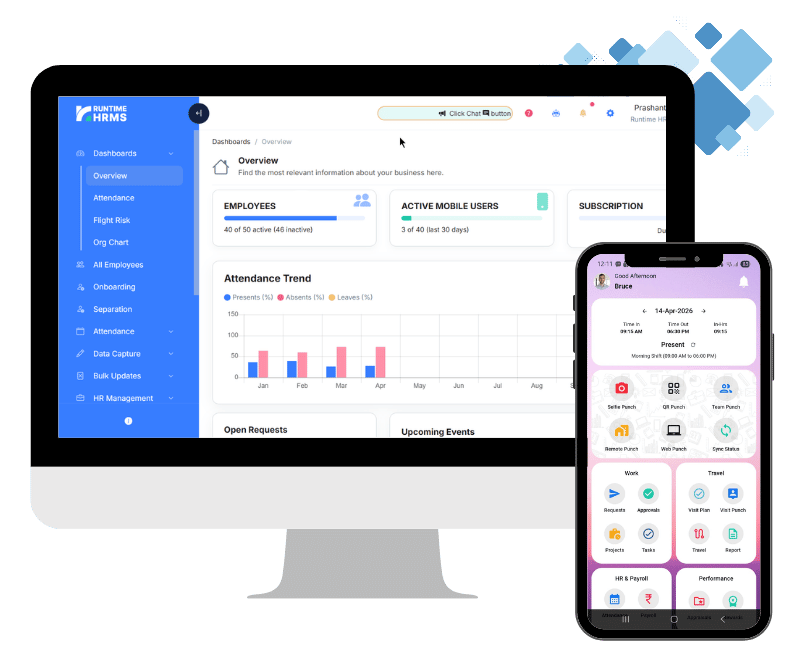
At Runtime HRMS, gratuity is tracked automatically from Day 1. The moment an employee’s profile is set up, the system starts provisioning gratuity monthly based on their Basic Salary and service period. By the time they exit, the number is ready – no last-minute spreadsheet, no guesswork, no risk of getting it wrong.
Ready to Simplify Payroll & Gratuity Management?
Runtime HRMS helps HR teams manage salary structures, payroll, employee exits, statutory calculations and gratuity-related payroll processes in one connected system.
Book Your DemoCommon Gratuity Calculation Mistakes HR Teams Should Avoid
Calculating gratuity on CTC, or only on basic salary
Gratuity is worked out on “wages” as the Labour Code defines them. That is not your full CTC, and it is not always just the basic pay on your payslip. If the allowances that the Code excludes add up to more than half of total remuneration, the extra amount is added back into wages. Check your salary structure against this definition before you run the formula.
Getting the six-month rule wrong
For regular employees, service is counted in whole years, and a leftover period of more than six months counts as one more full year. So 7 years and 8 months is treated as 8 years, while 7 years and 4 months stays at 7. Fixed-term employees are different: they are paid in proportion to the actual time worked.
Applying the five-year rule to everyone
Five years of continuous service is the general condition, but not for every exit. It is waived when employment ends because of death or disablement, or because a fixed-term contract expires. The Central Government can also notify other events. Do not tell a family or an employee “no gratuity” without checking which situation applies.
Missing the fixed-term employment change
Since the Labour Codes took effect on 21 November 2025, a fixed-term employee who is directly engaged by the employer under a written contract can receive gratuity after completing one year under that contract. The amount is pro-rata. If your team still applies the five-year rule to these employees, update your process now.
Checking gratuity only at final settlement
Once gratuity becomes payable, the employer has to calculate the amount and inform the employee. Reconstructing joining dates, service breaks and wage history at that point is where errors happen. It is good practice to keep service records and the wage details you need for gratuity up to date all through employment, so the calculation at exit takes minutes.
Check Our Other Calculators & Helpful Resources
Frequently Asked Questions About Gratuity Calculation in India
Is gratuity calculated on gross salary or basic salary?
Gratuity calculated on Basic Salary plus Dearness Allowance, not on gross salary or on CTC.
Can an employer forfeit gratuity?
Yes, but only in specific circumstances.
Always check with: Ministry of Labour