

Leave Encashment is the topic in every organization which attracts the same question from employees leaving the company.
“How many leaves will I get paid for?”
And every time, the answer depends on three things- which leaves are actually encashable. How the calculation works. And how much of that payout is tax-free.
If any one of these wrong and you’re either overpaying, underpaying, or creating a tax problem that shows up in the Form 24Q reconciliation six months later. So let me walk through all of it – clearly, practically, without the legal jargon.
Which Leaves Can Actually Be Encashed and Which is Not?
This is where most of the confusion starts. Not all leave types are encashable – and the rules are fairly specific.
Earned Leave (EL) / Privilege Leave (PL) – This is the only leave type that is encashable under Indian labour law. Earned leave accumulates based on days worked. Under the Factories Act, workers earn 1 day of EL for every 20 days worked. Under most Shops and Establishments Acts, it’s typically 1 day for every 20 working days, or 15 days per year – whichever the company policy specifies. This leave can be carried forward and encashed at resignation or retirement.
Casual Leave (CL) – Use it or lose it. Casual leave is meant for short-term personal needs – a day here, a day there. In almost every state, unused CL lapses at the end of the year. It cannot be encashed – not during service, not at resignation, not at retirement. Any company that encashes casual leave is doing it as a discretionary benefit, not a legal requirement.
Sick Leave (SL) – Same story. Sick leave is for medical emergencies and health-related absences. It cannot be encashed under Indian labour law. If an employee doesn’t use their sick leave, it lapses. Some companies allow carry-forward of SL for a limited period – but encashment is almost never permitted.
Maternity / Paternity Leave – Statutory leave. Not encashable.
Compensatory Off – Given for working on a holiday or weekly off. Not encashable as a rule – though some companies pay it out if the comp-off isn’t availed within a specified window.
The bottom line: only earned leave / privilege leave is encashable. Everything else either lapses or carries forward within limits – it doesn’t convert to cash.
How Much EL Can an Employee Accumulate?
Under the Factories Act, the maximum carry-forward is 30 days. Under most state Shops Acts, it’s 30 to 45 days – Maharashtra and Delhi allow 45 days, Karnataka 30 days, Tamil Nadu does not permit carry-forward at all.
Your leave policy must specify the carry-forward limit applicable to your state. If you operate across multiple states, you need state-specific leave policies – or at minimum, a baseline policy that complies with the most restrictive state.
Also check with: Ministry of Labour
The Leave Encashment Formula
Leave Encashment = (Basic Salary + DA) ÷ 30 × Number of Unused EL Days
There are three things that every HR must keep in mind:
One – the base is Basic + DA only. Not gross salary. Not CTC. HRA, conveyance, special allowance, medical allowance – none of these are included in the calculation base. Using gross salary results in significant overpayment and inflates the PF wage interpretation under the 50% basic rule.
Two – the divisor is 30, not 26. The 26-day divisor is used for LOP calculations under the Minimum Wages Act. Leave encashment uses 30. Your leave policy must specify which divisor you use – and you must apply it consistently. Using different divisors for different employees is how labour complaints get written.
Three – use the final salary, not the average. Leave encashment is calculated on the last drawn Basic + DA at the time of exit – not the average over the last few months, unless your policy specifically says otherwise.
Understand With an Example
Sunita works as a Quality Manager in Gurugram. Her Basic + DA = ₹45,000 per month. She has 24 days of unused earned leave at the time of resignation.
Leave Encashment = ₹45,000 ÷ 30 × 24 = ₹36,000
Now – how much of this is taxable? The tax treatment changes completely depending on when the encashment happens.
During active service – Fully taxable as salary income. No exemption under Section 10(10AA). If your company has an annual EL encashment policy – where unused leaves are paid out at the end of each financial year – that entire payout is taxable.
There is a Section 89 relief available – Employees can file Form 10E with their ITR to soften the tax hit if the lump-sum payout pushes them into a higher bracket that year. But that’s a relief mechanism, not an exemption. The income is still taxable – Form 10E just spreads the pain a little.
At resignation or retirement – Partially exempt under Section 10(10AA) for private sector employees. The exemption is the least of these four amounts:
- Actual leave encashment received
- 10 months’ salary (Basic + DA) based on last drawn salary
- Cash equivalent of leave to the credit (capped at 30 days per year of service)
- ₹25 lakh (lifetime aggregate cap)
One more thing worth mentioning here – The ₹25 lakh ceiling was ₹3 lakh until Budget 2023 changed it. That’s a significant jump, and it actually makes a real difference for employees who’ve spent 15-20 years at the same company with a decent leave balance. Both old and new regime taxpayers can claim it.
This is why collecting a self-declaration from every resigning employee about prior leave encashment exemptions claimed is not optional – it directly affects how much TDS you deduct and what goes into Form 24Q.
For government employees – Fully exempt at retirement. No upper limit.
On death – Payout to legal heirs is fully exempt with no ceiling.
How Runtime HRMS Handles Leave Encashment
Leave encashment during Full and Final Settlement is one of those calculations that looks straightforward but has enough variables to go wrong – leave balance accuracy, correct salary base, right divisor, prior exemption tracking.
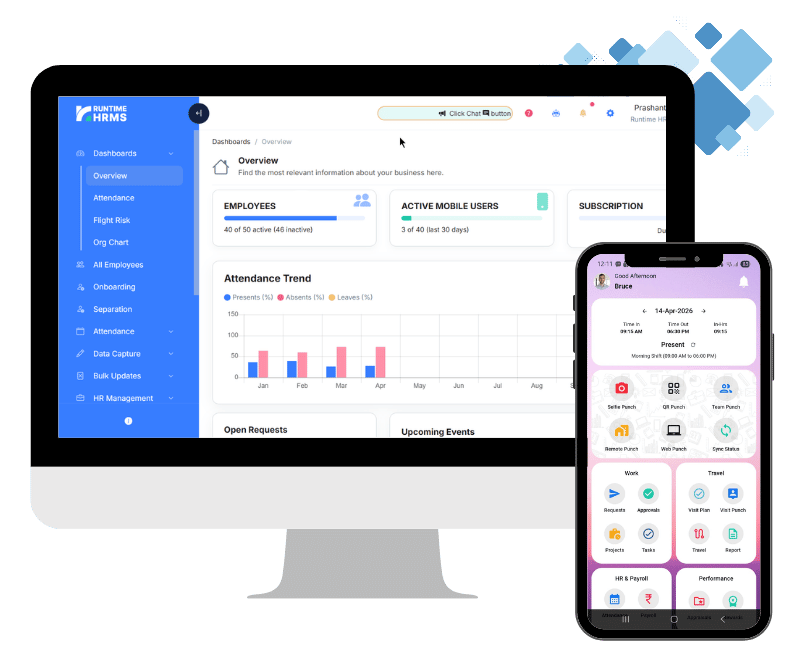
At Runtime HRMS, leave balances are updated in real time from attendance data. When an employee’s exit is processed, the system calculates leave encashment automatically on Basic + DA, applies your configured divisor, and feeds the amount into the FnF summary. Nothing to compile manually. Nothing to miss.
Quick Summary
- Only Earned Leave / Privilege Leave is encashable – CL, SL, maternity leave are not
- Carry-forward limits: 30 days (Factories Act), 30-45 days (Shops Acts, state-specific)
- Formula: (Basic + DA) ÷ 30 × Unused EL Days – use Basic + DA only, not gross
- Divisor is 30 for leave encashment – not 26
- During service: fully taxable
- At resignation/retirement: exempt up to ₹25 lakh (lifetime aggregate) under Section 10(10AA)
- Always collect prior exemption declaration from resigning employees
- Reconcile leave balances monthly – not just at exit
Frequently Asked Questions
Can casual leave or sick leave be encashed in India?
No – under Indian labor law, only earned leave (also called privilege leave) is encashable. Casual leave and sick leave lapse if unused.
Is leave encashment calculated on gross salary or basic salary?
Leave encashment is calculated on Basic Salary plus Dearness Allowance. HRA, conveyance, special allowance, and other components are excluded.
Try Our Calculators For: