
Quick Answer: What Should an HR Compliance Audit Cover in India?
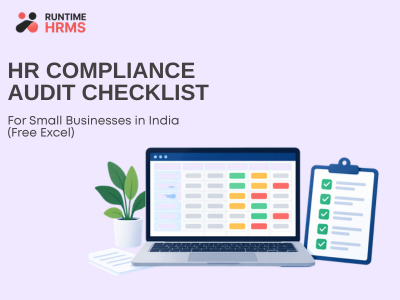
An HR compliance audit checks, with proof, that your company follows the labour, payroll, tax and workplace rules that apply to its size and state. The free Excel checklist below has 61 checks in 11 areas.
- Enter your headcount, and the sheet greys out checks that do not apply to you yet.
- Mark each check Pass, Flag, Fail or N.A., and note the evidence you can show.
- The summary gives a score and tells you whether you are Red, Amber or Green.
29 checks are marked Critical, so start there. Do a full audit once a year and a quick Critical re-check every quarter.
HR compliance audit checklists are most of them look the same. A long list of bullet points, “ensure PF is paid”, “ensure POSH is in place”, and at the end nothing to tell you how you actually did. You finish reading and you still do not know if your company is in good shape or not.
Why Most HR Compliance Audit Checklist Don’t Help
An audit is different from a reminder. It needs three things a plain list does not give you. Proof that each item is really done, a sense of which gaps matter first, and a filter for what applies to a company of your size. A 12-person company and a 320-person company do not face the same rules, and pretending they do wastes the time of whoever is running the audit, usually one HR person.
That is how I built the checklist on this page. Each check has the evidence you should be able to show, a priority, and the headcount at which the rule usually starts to apply.
Free HR Compliance Audit Checklist (Excel)
61 checks in 11 areas, with an evidence column, a headcount filter and an automatic score. Editable and free.
⬇ Download Free HR Compliance Audit Checklist ExcelWhat Is an HR Compliance Audit Checklist?
Short answer: HR compliance audit checklist is a planned review of your HR records and practices against the laws that apply to your business, ending in a list of gaps with owners and dates.
It is not a legal opinion, and it is not an inspection. You do it yourself, ahead of time, so that an inspector, a PF officer, an employee complaint or a due-diligence team does not find the gap before you do. The output that matters is not the score. It is the action list.
Since the four Labour Codes came into force on 21 November 2025, there is one more reason to do it now. Central Rules under the Codes were notified in May 2026, but several states are still finalising their own rules. That means parts of your checklist may change state by state over the next few months, and a yearly audit with a mid-year re-check is a safer rhythm than a one-time exercise.
What the HR Compliance Audit Checklist Has
The HR compliance audit checklist has 61 checks in 11 areas, each with a priority, an applicability trigger and an evidence note, plus an automatic score.
| Area | What it covers |
| 1. Registrations | Shops and Establishments, EPF, ESIC, Professional Tax, LWF, contract labour |
| 2. Employee records | Appointment letters, registers, personnel files, nominations |
| 3. Wages and payroll | Timely payment, minimum wage, the 50% wage rule, payslips, deductions, overtime |
| 4. PF, ESI and Professional Tax | Deposits, ECR, ₹25,000 EPF ceiling, UAN, ESI limit |
| 5. Income tax (TDS) | Deduction, deposit, quarterly statements, certificates, declarations |
| 6. Leave and working conditions | Leave policy, hours, maternity benefit, creche, safety |
| 7. POSH | Internal Committee, policy, awareness, annual report, records |
| 8. Exit and settlement | FnF in 2 working days, gratuity, notice recovery, letters |
| 9. Policies and governance | Standing orders, grievance process, code of conduct, fixed-term tracking |
| 10. Employee data (DPDP) | Data mapping, notice, access, vendors, breach response |
| 11. Inspection readiness | One folder, closed notices, action plan |
Three things in the sheet are different from the usual checklist, and I would like you to try them before you decide it is just another Excel.
First, the evidence column. For every check there is a note on what you should be able to put on the table, such as the ECR and challan for PF, or the signed acknowledgement for a policy. If you cannot find the document in two minutes, the honest status is not Pass.
Second, the priority tag. Twenty-nine checks are Critical, which means legal exposure or direct impact on an employee’s pay or safety. The other 32 are Review, which are good practice or lower exposure. When time is short, and it usually is, you fix the Critical Fails first.
Third, the headcount filter. Type your number of employees into one cell, and the checks that start only at a higher headcount turn grey and drop out of the score. A company with 8 employees should not be marked down for not having standing orders.
Which Checks Apply at Your Size
Most obligations begin at 10, 20, 50 or 300 employees. The thresholds below are the ones built into the Excel filter.
| Headcount | What typically comes into scope |
|---|---|
| Any size | Shops and Establishments registration, minimum wage, payslips, TDS, Professional Tax (state-wise), registers, FnF timelines, safety basics |
| 10 and above | POSH Internal Committee, ESIC (20 in some states), gratuity, maternity benefit |
| 20 and above | EPF, statutory bonus, grievance redressal mechanism |
| 50 and above | Contract labour registration and licences (the threshold was 20 earlier), creche |
| 300 and above | Standing orders, permission rules for layoff, retrenchment and closure |
These are guides, not final answers. State rules, the kind of establishment and wage limits can change the position, so confirm any borderline item with your CA or labour law professional. Also be careful about how you count. Some laws count only employees or workers, some count everyone employed over the past 12 months, and contract staff may or may not be included.
The Critical Checks, Area by Area
If you only have a few hours, work through these. They are the checks where a gap costs real money or hurts an employee directly.
Wages and payroll. Wages paid within the time the Code on Wages allows, which for monthly wages means by the 7th of the following month. Every employee at or above minimum wage. Basic, DA and retaining allowance forming at least 50% of total remuneration, which is the one most salary structures built before the Codes now fail. Payslips issued every month. Deductions only where permitted and documented. Our payroll readiness checklist covers the monthly side of this in more detail.
PF, ESI and Professional Tax. PF and ECR by the 15th. ESI by the 15th for employees within the ₹21,000 limit. Professional Tax as per your state schedule. And since the EPF wage ceiling moved to ₹25,000 from 17 September 2026, check that your payroll settings carry the new ceiling with the right effective date, wherever your PF policy follows the ceiling. The details are in our EPF wage ceiling guide.
Income tax. TDS deducted correctly and deposited by the 7th, quarterly statements filed, and TDS certificates issued on time.
Records. Signed appointment letters, a current employee register, an attendance register that matches payroll days, and a wage register. These are the first four things anyone will ask to see, and they are also the ones most often out of date.
POSH. Internal Committee with an external member, and the annual report submitted to the District Officer.
Exit. Full and final settlement within 2 working days of the last working day, and gratuity eligibility checked for every leaver, with payment within 30 days. See our guide on full and final settlement.
Governance. An action plan with an owner and a date for every finding. This sounds obvious, but an audit with no action plan is just a document.
The remaining 32 Review checks are in the Excel, and I would not skip them. They tend to be the things that become Critical a year later.
How to Run the Audit in Half a Day
First open the HR compliance audit checklist and enter your headcount, collect the evidence first, then mark statuses.
- Open the Summary sheet and enter your headcount in the yellow cell.
- Ask your accounts or payroll person for the PF, ESI, PT and TDS challans and returns of the last 12 months, and keep them in one folder. This step saves more time than any other.
- Go through the Checklist sheet area by area. For each check, open the evidence in column H. Mark Pass only if you can show it.
- Use Flag when the requirement is partly met, for example the register exists but is two months behind. Use Fail when it is missing. Use N.A. only when the item truly does not apply, such as no contractors.
- For every Flag and Fail, write an owner and a date. Start with the Critical ones.
- Look at the Summary. The result line stays on “In progress” until every in-scope check has a status.
Do not try to do it in one sitting if you are the only HR person. Do one area a day, and the whole thing takes a week without taking over your calendar.
How to Read Your Score
In the HR compliance audit checklist, the critical Fails decide your color first. The percentage only matters after that.
Pass counts as 1 point, Flag as half and Fail as zero. The score is the points divided by the checks in scope.
| Result | When it shows | What to do |
|---|---|---|
| Red | One or more Critical checks failed | Fix these first, whatever the percentage says |
| Amber | No Critical Fail, but a Critical Flag, or the score is below 85% | Close the flagged items in the next 30 to 60 days |
| Green | No Critical Fail or Flag, and 85% or higher | Keep evidence current and re-check every quarter |
Checks you mark N.A. are left out of the score, and the result line stays on “In progress” until every in-scope check has a status. A Fail on a Review check will not turn the sheet Red, but it still pulls the score down, so do not park it for later.
The 85% cut-off is my own working rule for this sheet, not a legal standard. Change it if your risk appetite is different.
One more honest thing. A Green does not mean you are legally safe. It means that against these 61 checks, and the way you marked them, you are in good shape. The sheet is only as honest as the person marking it.
A Simple Calendar for: HR Compliance Audit Checklist
Monthly for payments, quarterly for Critical items, yearly for the full audit.
| When | What to check |
|---|---|
| Every month | Wages by the 7th, TDS deposit by the 7th (30 April for March), PF and ESI by the 15th, Professional Tax and Labour Welfare Fund as per your state’s due dates, payroll variance |
| Every quarter | Re-check all Critical items, TDS statements, open Flags and Fails from the last audit |
| Every year | Full audit, POSH annual report, bonus, TDS certificates, policy review, data access review |
| When the law changes | Revisit the affected rows, for example after a new state rule, a wage ceiling change or a headcount milestone |
The last row is the one people forget. The EPF ceiling change on 17 September 2026 is a good example, because a checklist that was last reviewed before that date will not show it.
Where Excel Stops Being Enough
An Excel audit is a good fit when you have one person running it and a few records. It starts to hurt when the evidence is scattered, such as payslips in one place, registers in another and policies in email attachments, and when you have to rebuild the same proof every year.
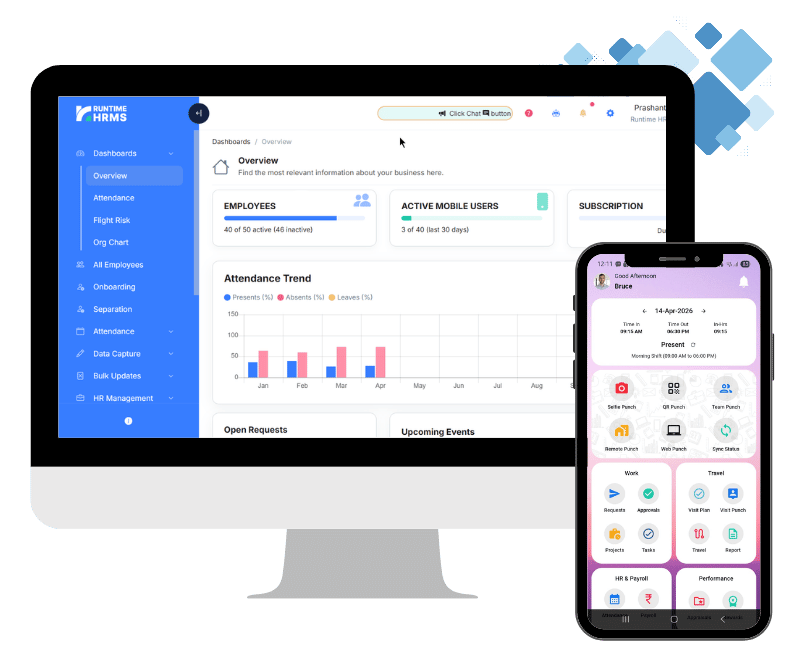
Runtime HRMS keeps payroll with PF, ESI, Professional Tax and TDS in one system, and EPF settings can be set with an effective date, which is useful when a ceiling changes. HR letters and policies, attendance and leave sit in the same place, and Employee Separation Management handles the exit side, so the records an audit asks for are produced as part of the normal work. It also has 50+ MIS reports that you can use to pull the numbers for your checks.
Tired of Rebuilding Audit Proof Every Year?
Runtime HRMS keeps payroll with PF, ESI, Professional Tax and TDS, attendance, leave, HR letters and employee separation in one system, so your records are ready when an audit asks for them.
Book Your DemoOur Other Helpful Resources
Disclaimer
This checklist and guide are for general information and self-assessment. Thresholds, due dates and forms vary by state, type of establishment and the law in force, and some state rules under the Labour Codes are still being finalised. This is not legal advice. Please confirm the points that apply to you with your CA, labour law professional or compliance consultant.
Official references: Ministry of Labour and Employment | EPFO | ESIC | Income Tax Department