

Quick Answer
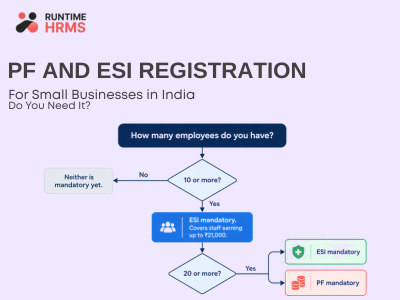
PF and ESI Registration for Small Business: PF is mandatory once you have 20 or more employees. ESI is mandatory once you have 10 or more (20 in some states) and covers staff earning up to ₹21,000 a month. From 17 September 2026 the PF wage ceiling is ₹25,000, up from ₹15,000.
Both are due by the 15th of the next month. Late payment costs 12% a year in interest plus damages. Use the free sheets below to see what each employee will cost you.
Someone starts a business, hires the tenth or the twentieth person, and then a CA or a neighbor says “ab PF-ESI lagega”. Nobody explains what that really means for the monthly bill.
I run payroll software for small businesses at Runtime HRMS, so I see the same confusion again and again. The rules are not hard. They are just scattered across the EPFO site, the ESIC site and a dozen blogs that disagree with each other. This guide puts it in one place.
PF and ESI Registration for Small Business in India
| Your headcount | PF (EPF) | ESI |
|---|---|---|
| Under 10 | Not mandatory. Voluntary registration is possible | Not mandatory |
| 10 to 19 | Not mandatory | Mandatory in most states. Some states start at 20 [VERIFY your state] |
| 20 or more | Mandatory | Mandatory |
Three things people miss:
Count everyone you pay. Contract staff paid directly by you count. Staff supplied by a licensed contractor are usually the contractor’s problem, but check your agreement.
ESI covers only people earning up to ₹21,000 gross a month. If your 12 employees all earn ₹30,000, ESI technically applies to the establishment but covers nobody. Do check before you assume.
Once covered, you stay covered. Dropping from 21 to 17 people does not cancel your registration.
The ₹25,000 change, in plain words
Till 16 September 2026 the PF wage ceiling was ₹15,000. From 17 September 2026 it is ₹25,000 (notification S.O. 5109(E). October 2026 is the first full month where it applies.
What it means for you:
- Employees whose PF wage is between ₹15,000 and ₹25,000 can now come under mandatory PF.
- Your employer share goes up for those employees. At 12% plus EDLI of 0.5%, that is up to ₹1,250 extra a month for someone whose PF wage is ₹25,000 or more.
- Admin charge is 0.5% of PF wages with a minimum of ₹500 a month for the establishment.
PF wage means basic plus dearness allowance, and the new Labour Codes push the wage base up because allowances are capped at 50% of total pay. This is the part where I would ask a CA.
A worked example
Take a manager with a gross salary of ₹40,000 and basic of ₹20,000 (50%).
| Item | Per month |
|---|---|
| PF wage (basic, below ₹25,000 ceiling) | ₹20,000 |
| Employer PF (12%) | ₹2,400 |
| EDLI (0.5%) | ₹100 |
| Employee PF deducted (12%) | ₹2,400 |
| ESI | Not applicable (above ₹21,000) |
| Extra cost to you over salary | ₹2,500 (+ share of admin charge) |
Compare that with a ₹18,000 gross employee: PF on ₹9,000 basic is ₹1,080, and ESI adds ₹585 from you (3.25%) and ₹135 from the employee (0.75%). Roughly 9% on top of salary. Across a team this adds up, which is why I built the sheet below.
Download the Free PF + ESI Cost Sheet (Excel)
Type your headcount and see if PF and ESI apply. Then replace the example salaries with your own. It uses the ₹25,000 PF ceiling and the ₹21,000 ESI limit, and shows the extra cost from the new ceiling.
How to register (step by step)
PF (EPFO)
- Get your documents ready: PAN of the business, address proof, bank account, DSC of the signatory (digital signature), partnership deed or incorporation papers.
- Register on the EPFO employer portal (unifiedportal-emp.epfindia.gov.in) and get your establishment code.
- Create a UAN for each employee through the portal, with Aadhaar, bank account and Form 11 details.
- File the ECR every month and pay the challan.
Timeline: register within about 30 days of becoming covered.
ESI (ESIC)
- Register the establishment on the ESIC portal (esic.gov.in) within 15 days of the law applying to you.
- Register each eligible employee and issue an IP number and temporary card. Do this within 10 days of joining.
- Pay contribution monthly on the portal and file the half-yearly return.
PF and ESI Deadlines you cannot miss
| What | When |
|---|---|
| PF contribution and ECR | 15th of next month |
| ESI contribution | 15th of next month |
| ESI half-yearly return (Apr to Sep) | 11 November |
| ESI half-yearly return (Oct to Mar) | 11 May |
Annual PF/ESI Calendar
What a late payment really costs
| Charge | PF | ESI |
|---|---|---|
| Interest | 12% a year, simple (Sec 7Q) | 12% a year, simple |
| Damages | 1% of arrears per month for defaults from June 2024 (Sec 14B). Older slab was 5/10/15/25% for earlier defaults. | Up to 25% of arrears, depending on delay [VERIFY] |
Be careful here. Many blogs still show the old slab of 5%, 10%, 15% and 25%. The rate was changed to 1% a month in June 2024. Confirm the figure on the EPFO site before relying on it. Section 14B damages are capped at the amount of arrears. Courts have also upheld penalties above what tribunals reduced, so do not assume you will get relief. Besides money, there is prosecution risk if deductions were taken from employees’ salary and not deposited. That is the case I would never take lightly.
I registered late. Now what?
- Do not wait for a notice. Register now.
- Work out the months you missed. Pay the contribution for each month.
- Add interest at 12% a year from each due date.
- Expect a damages inquiry. Keep payment proof ready.
- Ask your CA whether back-dated employee registration is needed.
Employer share for missed months is your cost. The employee share you did not deduct is generally also yours to bear.
I got a notice. What do I do?
- Read the date, the section and the amount. Do not ignore the date.
- Collect challans, ECRs, bank statements and salary registers for the period.
- Match each month to a challan. Most notices are mismatches, not fraud.
- Reply in writing before the date. If you need time, ask for it before the date passes.
- Keep a copy of everything you send.
How Runtime handles PF and ESI
Payroll is where PF and ESI actually live, so that is where we handle them. In Runtime’s payroll software, statutory deductions are calculated with the salary, and the PF/ESI figures flow into the payslip. New joiners also matter. Registration starts at onboarding when you collect Aadhaar, PAN, bank and UAN details, and employee verification helps you confirm the documents.
If you are on the free plan, up to 5 employees; paid plans start per employee per month. See the pricing page for current plans.
Tired of working out PF and ESI by hand every month?
Runtime HRMS keeps salary, PF and ESI in one payroll run, so numbers match when it is time to pay.
Book Your Demo