
Introduction
Do you know that most companies in India still onboard new employees the same way they do in 90’s. A stack of forms or shared folder of PDFs. A WhatsApp message saying, “come at 10, ask for Priya.” And then we wonder why new hires quits the job in three months.
This is very painful and cost affective problem, India’s corporate attrition rate hovers around 16–17% annually. Sectors like financial services seeing churn as high as 24%, and the big part of this is the problem starts from day one.
The data shows that only 12% of employees feel their company does onboarding well. And the remain 88% experience leaves them confused, undertrained, and put in situation that did they made the right choice.
But the good news is that you can automate the onboarding process, doesn’t matter you are big enterprises or a small organization. Here’s everything you need to know about automated employee onboarding.
Why Traditional Onboarding Is Failing Indian Companies?
Just think about the manual onboarding process that used in many companies, HR sends an email with 12 attachments. The new joiner fills out forms by hand and then someone enter that forms re-enter into a system anyway. IT doesn’t have the laptop ready; the managers are busy in back-to-back meetings. By lunch on day one, the new hire is already second-guessing their decision.
The most common reasons that new hire leave the company in the first 90days, due to mismatch between job expectations and reality (30.3%), a lack of connection with team or company culture (19.5%), and a poor onboarding experience (17.4%). The poor onboarding experience directly causes nearly 1 in 5 early exits.
The average cost to onboard a new employee is ₹1.5 lakh (this may vary as per organisation structure) but when you add time, training and tools, it cost more than that. And if they leave early, you pay it all over again.
What Does Automated Employee Onboarding Actually Mean?
In any organization, automated employee onboarding doesn’t mean removing of human element, it means to reduce or removing paperwork, follow-up emails, time saving and manual data entry, so the HR team can focus on welcoming the new joiner.
A Proper Automated Onboarding System Handles
Before day one (Pre-boarding): This process includes digital offer letters, document collection, background verification, IT request triggers, and policy acknowledgement. You can complete all these before the employee walks in the door.
Day one and week one: This includes auto-generated welcome emails, system access credentials, personalised checklists for the employee, manager, and HR. These are all synced at one place.
First 30–90 days: Automated check-ins, task reminders, compliance tracking, and payroll setup without a single manual entry.
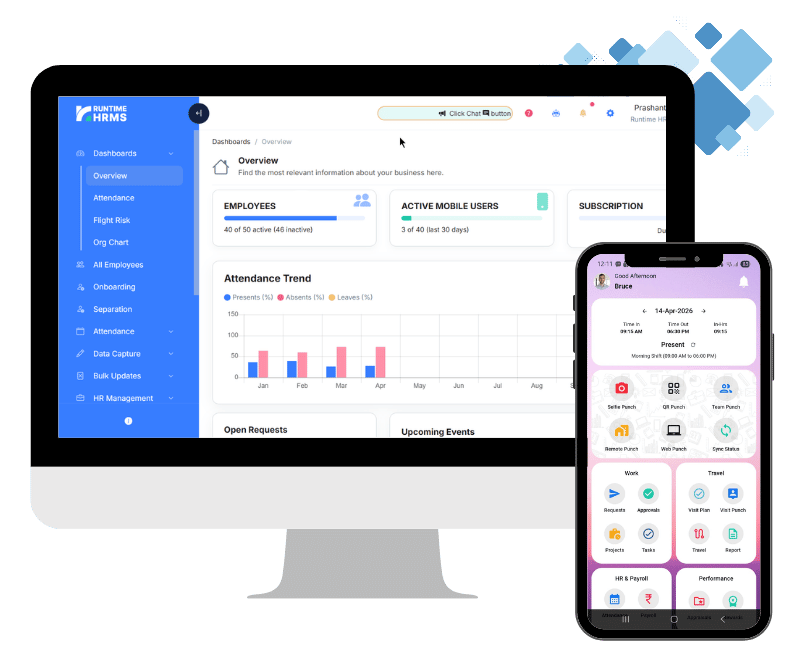
With Runtime HRMS’s HR Management module, Indian companies can set up self-onboarding workflows where new joiners complete their own documentation digitally, it reduces HR workload.
The Real Impact of Automating Employee Onboarding in India
The companies who follow automated employee onboarding, their new hire retention by 82% and productivity by over 70%. In India specifically, 64% of employees report that role-specific onboarding significantly improves job clarity. When a new joiner knows exactly what’s expected of them from day one, they ramp up faster and stay longer.
Here’s what changes you can expect when you automate onboarding:
For HR teams: No more chasing employees for documents, no need to update records manually, also no need to worry about the new joiner welcome email. The system handles the follow-up so HR can focus on the human part of the job.
For new joiners: They feel organised, structured and a smooth professional experience that signals the company is organised and cares. 91% of new hires who received an effective introduction to company culture say they feel connected to their workplace.
For managers: They have their auto-generated task lists, means managers know exactly what they need to do on day one, day seven, and day thirty. No need to ask HR again and again.
5 Things You Can Automate in Onboarding Right Now
- Document collection and verification: Instead of using emailing system, use a digital onboarding portal where new joiners upload Aadhaar, PAN, bank details, and educational certificates directly. Runtime HRMS’s Employee Management module keeps all documents in one place, accessible anytime, audit-ready from day one.
- Payroll setup: Manual payroll setup of new joiners is one of most error + time consuming task of every HR. Automated onboarding feeds employee data directly into payroll processing. Salarystructure, PF, ESI registration, TDS setup, this all automate, without error and duplication.
- Attendance and leave access: With the automate onboarding new joiner can mark attendance and apply for leave from day one, not week three. With Runtime HRMS’s Time & Attendance system, geo-fenced mobile attendance is ready the moment the employee is added to the system.
- Employee self-service activation: This is the biggest pain area of HR, answering the same questions repeatedly — “where’s my payslip?”, “how do I apply for leave?”, “what’s my CTC breakdown?” The Runtime Workman app gives every new joiner 30+ self-service features from day one, so that HR can focus on other important tasks.
- Compliance tracking: Every time when you hire a new joiner, needs proper documentation, UAN registration, ESIC enrolment, and salary structure compliance from day one. With the automated onboarding, these can be done easily.
Summary
Onboarding isn’t HR admin; it is your first opportunity to show a new employee what kind of company you are. The automated employee onboarding is a structured journey where the administrative part is handled automatically, and the human side, introductions, culture and mentorship.
This is fact that the employees who experience structured onboarding are 69% more likely to stay with the company for three years. Because automated onboarding doesn’t just save time. It saves people.
If you’re ready to build a proper onboarding process for your team, Runtime HRMS gives you everything you need, from self-onboarding portals to payroll automation to mobile attendance. All in one platform, especially built for Indian companies.
No matters how big or small organisation you are, the only matters how and where you want to take your organisation in coming years.
“Want to see how Runtime HRMS handles onboarding for your team size? Book a free demoand we’ll walk you through it.”
Frequently Asked Question
What is automated employee onboarding?
The automated employee onboarding means no paperwork, it is the process of using HR software to handle tasks like document collection, PF/ESI registration, payroll setup, offer letter generation, and attendance activation, without manual follow-up from HR.
What documents are required during employee onboarding in India?
In India every new joiner needs to submit: PAN card (mandatory for TDS), Aadhaar card (for UAN/EPFO enrolment), bank account details, educational certificates, previous employment relieving letter, and a signed appointment letter.
How does HRMS software help in employee onboarding?
An HRMS like Runtime HRMS automates the entire onboarding process, from self-onboarding portals where employees fill their own details, to automatic payroll setup, PF/ESI registration, document storage, attendance activation, and letter generation. This saves HR teams time and energy.