
Net salary calculation after all deductions is not a simple and easy task, sometimes a small difference in salary can cause big issue. It happens when an employee checks their bank account. Then they open their payslip — and the number doesn’t match what they thought they’d get.
I’ve seen this cause real trust issues between employees and companies. Not because anyone did anything wrong. Just because nobody took 10 minutes to explain how the deductions work. So let me do that now. For HR managers who need to explain it to employees. And for business owners who want to make sure their payroll is structured correctly.
Net Salary — What It Actually Means
Net salary is the amount that credited in the employee’s bank account every month. Nothing more, nothing less.
It’s what’s left after all statutory deductions — PF, ESI (where applicable), Professional Tax, and TDS — have been cut from the gross salary. Some companies also make additional deductions like loan recovery, advance adjustments, or voluntary NPS contributions. All of that comes out of gross before the final number hits the bank.
The relationship between the three salary terms most people confuse:
CTC is what the company spends. Gross salary is what the employee earns. Net salary is what the employee receives. Each one is smaller than the previous — and the gaps between them exist for specific, calculable reasons.
The Net Salary Calculation Formula
Net Salary = Gross Salary − Total Deductions
Total Deductions = Employee PF + ESI (if applicable) + Professional Tax + TDS + Any Other Deductions
Simple enough on paper. The complexity comes from calculating each deduction correctly — which is where most payroll errors happen.
Deductions
Employee PF (Provident Fund)
12% of Basic Salary plus Dearness Allowance. This goes entirely into the employee’s EPF account — it’s their retirement savings, not a tax. If basic salary is ₹25,000, PF deduction is ₹3,000.
For employees whose Basic + DA exceeds ₹15,000, the employer has the option to cap PF calculation at ₹15,000 — meaning the minimum deduction would be ₹1,800. Many companies contribute on the full basic instead, as an employee benefit.
ESI (Employee State Insurance)
Only applicable for employees whose gross salary is ₹21,000 per month or less. Employee contribution is 0.75% of gross salary. So for an employee earning ₹18,000 gross, ESI deduction is ₹135.
If an employee’s salary crosses ₹21,000 mid-year, ESI deductions continue until the end of that contribution period — they don’t stop the moment the salary crosses the threshold.
Professional Tax
A state-level deduction. Not applicable in all states — Delhi, Rajasthan, UP, and Haryana have no Professional Tax. In states like Maharashtra, Karnataka, and West Bengal, the monthly deduction ranges from ₹150 to ₹200 depending on the salary slab.
TDS (Tax Deducted at Source)
Calculated on estimated annual taxable income. The annual tax is divided by 12 to get the monthly TDS. Under the new tax regime (default from FY 2026-27), income up to ₹12.75 lakh is effectively tax-free for salaried employees. So many employees in smaller companies have zero TDS deductions.
For those with higher salaries, TDS changes through the year as investment declarations get updated — it’s not a fixed number every month.
Other Deductions
Salary advance recovery, loan EMIs, voluntary NPS contributions, or any other company-specific deductions. These vary by employee and company policy.
Check latest update in: EPFO
Complete Net Salary Calculation
Let me put this together for one employee so you can see exactly how it works.
Employee: Meera Location: Bengaluru (Karnataka — PT applicable) Tax Regime: New Regime
| Component | Amount |
| Basic Salary | ₹28,000 |
| HRA | ₹11,200 |
| Conveyance | ₹1,600 |
| Special Allowance | ₹7,200 |
| Gross Salary | ₹48,000 |
Deductions:
| Deduction | Calculation | Amount |
| Employee PF | 12% × ₹28,000 | ₹3,360 |
| ESI | Not applicable (gross > ₹21,000) | ₹0 |
| Professional Tax (Karnataka) | As per slab | ₹200 |
| TDS | Annual income ₹5,76,000 — within zero tax slab under new regime | ₹0 |
| Total Deductions | ₹3,560 |
Net Salary = ₹48,000 − ₹3,560 = ₹44,440
That’s what Meera gets in her bank account every month. And her CTC? Let’s check:
Employer PF = 12% × ₹28,000 = ₹3,360 Gratuity provision = 4.81% × ₹28,000 = ₹1,347
Annual CTC = (₹48,000 + ₹3,360 + ₹1,347) × 12 = ₹6,32,484
So Meera’s CTC is ₹6.32 lakh, her gross is ₹48,000/month, and her net salary is ₹44,440. Three different numbers — all correct, all for different purposes.
Try our: In-Hand Salary Calculator
Why Net Salary Changes Month to Month
Most employees assume net salary should be the same every month. And for most months, it is. But here’s when it changes:
- When there’s a Loss of Pay (LOP) — absent days without leave balance get deducted from gross, which reduces net.
- When TDS is recalculated — after investment declarations are submitted or updated, TDS changes for the remaining months of the year.
- When a salary increment kicks in — new gross means new PF deduction, possibly new tax liability.
- When a salary advance is being recovered — the EMI gets added to deductions that month.
- Explaining this proactively to employees — especially when net salary dips — prevents a lot of unnecessary HR queries and trust issues.
The 50% Basic Rule and Its Impact on Net Salary
This is something most employees don’t know — and many employers haven’t fully acted on yet.
Under the Labour Codes effective November 2025, Basic Salary plus DA must be at least 50% of total CTC. Companies that kept Basic low to reduce PF deductions now have a higher PF base — which means a slightly lower net salary for the same CTC.
If your employees are asking why their take-home changed without a salary revision, this might be the reason. Worth communicating clearly.
How Runtime HRMS Handles This
When I think about how many payroll queries come from employees who simply don’t understand their payslip — it’s a solved problem with the right tools.
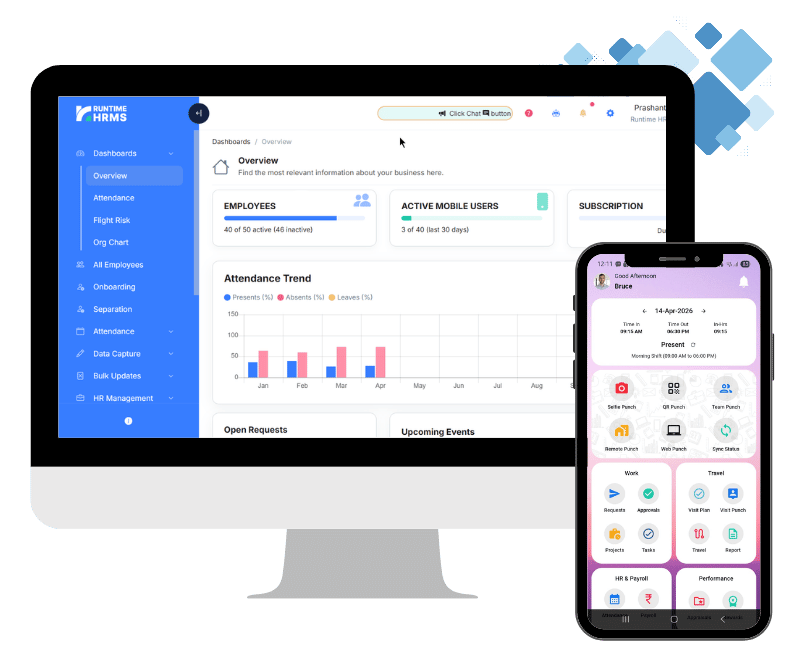
Runtime HRMS generates detailed payslips that show every component of gross salary, every deduction with the calculation basis, and the final net salary — in a format that’s actually readable. Employees access their payslips on the Runtime Workman app and can see exactly how their number was arrived at.
The result? Fewer “why is my salary less this month?” messages to HR. And more time for HR to focus on work that actually matters.
Quick Summary
- Net Salary = Gross Salary − Total Deductions
- Deductions include: Employee PF (12% of Basic), ESI (0.75% if gross ≤ ₹21,000), Professional Tax (state-specific), TDS (based on annual income and tax regime)
- CTC > Gross > Net — all three are different numbers
- Net salary changes when there’s LOP, TDS revision, increment, or advance recovery
- Under Labour Codes 2025, higher basic = higher PF deduction = slightly lower net for same CTC
Frequently Asked Questions
Why is my net salary less than my gross salary?
Because statutory deductions are applied to gross salary before the money reaches your account. The main ones are Employee PF (12% of basic), Professional Tax (state-specific), and TDS (based on your annual income). ESI applies if your gross is ₹21,000 or below. All of these are deducted from gross to arrive at net salary.
Does net salary change every month?
For most employees, it stays the same month to month. It changes when there’s a Loss of Pay deduction, a TDS revision after investment declarations, a salary increment, an advance recovery, or a change in salary structure. HR should communicate proactively when net salary changes — it avoids unnecessary confusion.
Is PF deducted from gross salary or basic salary?
PF is calculated on Basic Salary plus Dearness Allowance — not gross salary. The employee contributes 12% of Basic + DA. So if your basic is ₹30,000 and gross is ₹55,000, PF is ₹3,600 — not 12% of ₹55,000.