

Quick Answer
The right payroll software for a small factory should do five things: record attendance and shifts, calculate overtime at twice the normal rate, run PF, ESI and Professional Tax with the salary, track advances, and settle workers who leave.
Runtime Payroll connects attendance, salary and statutory deductions in one monthly run. Try it with a test payroll on your own workers before you decide.
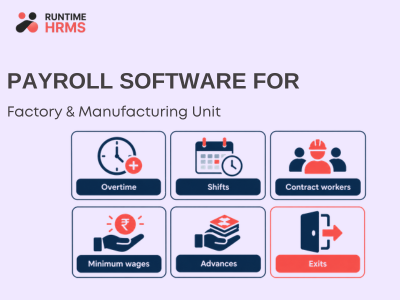
Dou you know what a Payroll Software for Factory & Manufacturing Unit can do? Most small factory or manufacturing units not only struggle with the salary, but they also struggle with everything around it.
The muster register is on paper. Three shifts, and one worker did a double. Overtime is in a supervisor’s notebook. Two daily-wage workers did not come on Tuesday, but one of them says he did. A contractor’s men are on site and nobody is sure who pays their PF. And on the 1st, somebody wants an advance against next month.
Then the accountant works it out over two days, and the owner finds a mistake after the payment.
This guide is for the owner of a workshop, a small factory or a manufacturing unit. It covers the payroll problems I see most, the rules that apply as you grow, and a free sheet for overtime. I am not a lawyer or a CA, so confirm anything specific with yours.
The Six Payroll Problems Of Factory & Manufacturing Unit
1. Overtime that nobody can prove
Under the Code on Wages, overtime must be paid at not less than twice the normal rate of wages. That is the rule most people know. The trouble is the proof: who worked how many extra hours, on which day, with whose approval.
A worked example. A worker earns ₹15,600 a month (Basic + DA). If you divide by 26 days and 8 hours, the normal rate is ₹75 an hour. Overtime at twice that rate is ₹150 an hour. Twenty hours of overtime adds ₹3,000 to the month.
Two things to be careful about:
- The divisor. Some units divide by 26, some by 30, some by the days of the month. Pick one rule, put it in writing, and use it every month.
- The limit. There is a quarterly overtime limit, and the figure I found differs across sources. I have seen 125 hours, 144 hours and, for some states, 50 hours. One source says Rajasthan applies a lower rate under older shop rules. I could not confirm any of this from an official text. Check your state’s current rules.
Overtime also generally needs the worker’s consent and a record. Keep the register.
2. Shifts and attendance on paper
A paper muster looks fine until someone disputes a day. Then you are arguing about handwriting. Shift workers, double shifts and weekly offs worked make it worse.
Biometric or face-based attendance removes most of the argument, because the record is made at the gate and not rebuilt at month end.
3. Contract and daily-wage workers
This is where the compliance risk sits in a small factory.
- If you pay a worker directly, they are generally your employee for headcount, PF and ESI, whatever you call them.
- If a contractor supplies workers, the contractor is responsible, but you may still be the principal employer, and you should know who is paying their wages and their PF.
- Under the OSH Code, the contract labor provisions apply from 50 contract workers, up from 20 earlier, and a contractor with fewer than 50 no longer needs a license under the Code.
Ask for proof of the contractor’s PF and ESI payments. If something goes wrong, the notice may come to you. See what to do about a PF or ESI notice.
4. Wages below the floor, and the 50% rule
Minimum wages are set by the state and by skill category. Your lowest paid helper is the first place to check.
The Code on Wages also says that if allowances are more than half of total pay, the excess is treated as wages. In practice that raises the wage base used for PF, gratuity and overtime. If your salary structure keeps basic very low, the numbers move when the rule is applied.
5. Advances and deductions
Advances against salary are normal in a factory. The risk is the pile-up. The Code on Wages caps total deductions in a wage period at 50% of wages. A worker with three advances and a canteen deduction can hit that quickly. Keep a running advance register with a clear recovery plan.
6. Workers who leave
Workers leave, some without notice. Under the Code on Wages, wages for a worker who is removed, retrenched or resigns are to be paid within two working days. State rules and your own policy may add detail. Keep the exit date, last working day and dues in one record. See our guide to full and final settlement.
| When | What applies | Where to read more |
|---|---|---|
| Any size | Wages by the 7th of the next month. Overtime at twice the normal rate. Professional Tax and Labour Welfare Fund as per your state. Minimum wages. | PT vs LWF |
| 10 or more | ESI for workers earning up to ₹21,000. Gratuity. Single OSH registration for establishments with 10 or more workers. | PF and ESI registration |
| 20 or more | PF (wage ceiling ₹25,000) and statutory bonus. Under the OSH Code, a unit with power becomes a “factory” at 20 workers (40 without power), up from 10 and 20 earlier. | After hiring 20 employees |
| 50 contract workers | OSH Code contract labour provisions and contractor licensing. | New Labour Codes |
The thresholds changed with the Labour Codes in November 2025, and many older blogs still show the old numbers. Check the date on any guide you read.
Download the Free Factory Overtime Sheet (Excel)
Enter each worker’s monthly wage and overtime hours. It shows the hourly rate, the overtime pay and total earnings, and flags where overtime is more than a quarter of someone’s pay. A second sheet tracks overtime hours per worker across a quarter against your state’s cap.
What goes wrong when payroll stays manual
- Overtime is paid from memory, and two workers get different amounts for the same hours.
- A worker who left in the middle of the month is still on the next sheet.
- PF or ESI is calculated on the wrong wage, and the notice comes a year later.
- The owner is the only person who knows how the sheet works.
None of these is dramatic. Each one costs a little time or money every month.
How Runtime Payroll fits Factory & Manufacturing Unit
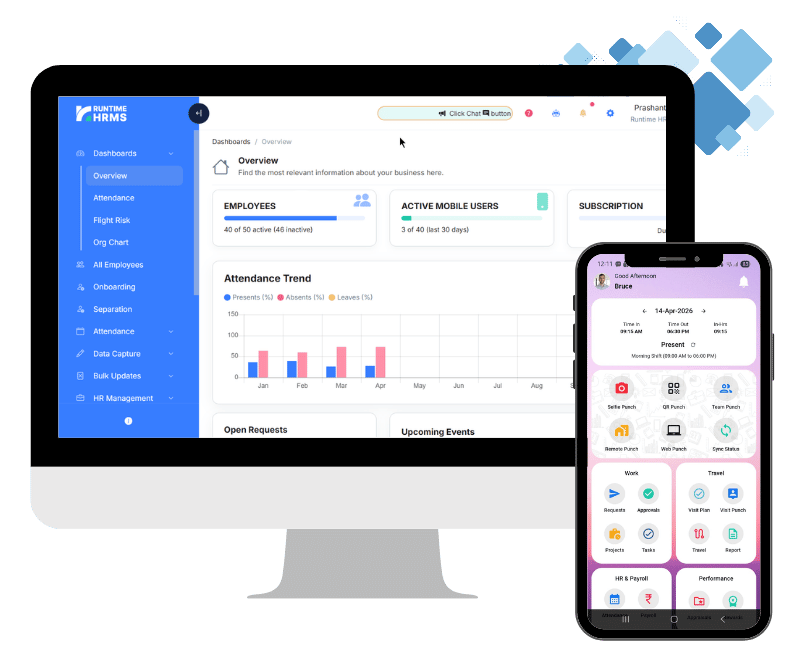
Runtime Payroll is built to run salary, statutory deductions and attendance together, which is where a factory’s work sits. It connects the pieces that usually live in different places.
- Attendance and shifts. Time and attendance supports shift rostering and biometric integration. Runtime Lens adds touchless face-recognition attendance, so a worker’s day is recorded at the gate.
- Payroll and statutory. Payroll runs PF, ESI, Professional Tax and TDS with the salary, so the payslip and the challan come from the same run.
- Workers on their phone. Workman lets workers see attendance, leave and payslips, so fewer questions reach you at month end.
- Exits. Employee separation keeps the exit date, notice and dues in one place.
The Free plan covers up to 5 employees and every plan has a 7-day free trial, so you can run a test payroll on your own workers before you decide.
Overtime, shifts and PF still on paper and Excel?
Run a test payroll on your own workers and see attendance, overtime and PF in one monthly run.
Book Your DemoFAQs
How is overtime calculated for factory workers in India?
Overtime is paid at not less than twice the normal rate of wages under the Code on Wages. Divide the monthly wage by your working days and hours to get the normal hourly rate, then multiply by two and by the overtime hours.
At how many workers does a unit become a “factory”?
Under the Factories Act it was 10 workers with power or 20 without. Under the OSH Code the figures are 20 with power and 40 without.
Is PF mandatory for a small factory?
PF becomes mandatory at 20 employees, with the wage ceiling at ₹25,000 from 17 September 2026.
Is ESI applicable to a factory with 10 workers?
In most states, yes, for workers earning up to ₹21,000 a month. Some states start at 20.
Do contract workers count for PF and ESI?
Workers you pay directly generally count. Workers supplied by a licensed contractor are usually the contractor’s responsibility but check your agreement and ask for proof of payment.
By when must a factory pay monthly wages?
Under the Code on Wages, before the expiry of the 7th day of the next month.