
Quick Answer
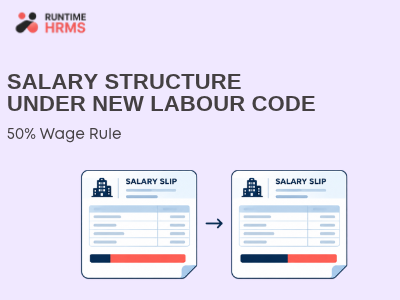
Under the Code on Wages, 2019, allowances such as HRA, conveyance and employer PF contributions cannot make up more than 50% of total remuneration. If they do, the excess is treated as “wages”. In practice, most employers now plan basic pay plus dearness allowance at 50% or more of CTC.
A higher basic raises PF and gratuity. If CTC stays the same, monthly take-home usually falls a little, while PF savings and gratuity rise. The Code has applied since 21 November 2025, and the Central Rules were notified on 8 May 2026.
Why the salary structure under new labour code matters now
For years, many salary slips looked alike: a small basic, a large HRA and special allowance, and a total that matched the offer letter. It was legal and it was common. It also kept PF and gratuity low, because both are calculated on basic.
The Code on Wages changes that. I am a director at Runtime HRMS and I speak to business owners about payroll every week. The questions I hear most are “Do I have to change every salary slip?” and “Will my employees take home less?” This guide to the salary structure under new labour code rules answers both in plain language. I am not a lawyer or a CA, so use it to prepare your questions and then check the points flagged.
What the Code on Wages says about wages
The Code defines “wages” as all remuneration, in money terms, payable under the terms of employment. It then lists items that are not counted as wages. According to law-firm summaries, these include:
- House rent allowance (HRA)
- Conveyance allowance
- The employer’s contribution to PF or pension
- Overtime allowance
- Commission
- Gratuity payable on termination
- Retrenchment compensation and similar payments
- Pay in lieu of notice
Basic pay, dearness allowance (DA) and retaining allowance, if any, are counted as wages.
The 50% rule in simple words
The Code adds a limit. If the excluded items together are more than 50% of the total remuneration, the extra amount above 50% is treated as wages. Employers cannot contract out of this.
Most advisers translate it for payroll like this: basic + DA should be at least 50% of total CTC. That is the safe way to design a salary structure under new labour code rules, and it is what the examples below use.
There is one point to raise with your CA or labour-law adviser. The Code’s wording tests the excluded items, such as HRA and conveyance, against 50%. A component like a “special allowance” is not on the excluded list. Some readers therefore argue that it already counts as wages. Others say it does not, which is why the 50% basic planning is common. Which view your company follows is a decision to take with professional advice.
Two other open points: whether employer PF counts inside the “total remuneration” figure, and how variable pay is treated. Secondary sources do not agree on these.
Salary structure under new labour code: a worked example
Take an employee with a monthly CTC of ₹50,000. For clarity, assume PF is calculated on actual basic pay, and ignore income tax and Professional Tax. (If your PF is on a ceiling amount, the difference is smaller, see below.)
| Monthly component | Old structure | New structure |
|---|---|---|
| Basic (40% before, 50% now) | ₹20,000 | ₹25,000 |
| HRA | ₹10,000 | ₹10,000 |
| Special allowance (balancing) | ₹17,600 | ₹12,000 |
| Gross salary | ₹47,600 | ₹47,000 |
| Employer PF (12% of basic) | ₹2,400 | ₹3,000 |
| CTC (gross + employer PF) | ₹50,000 | ₹50,000 |
| Employee PF (12% of basic) | ₹2,400 | ₹3,000 |
| Take-home (before tax) | ₹45,200 | ₹44,000 |
What changed, with the same CTC:
- Take-home is ₹1,200 a month lower (₹14,400 a year). Gross falls by ₹600 and employee PF rises by ₹600.
- ₹1,200 a month now goes into the employee’s PF account instead (₹600 from the employee and ₹600 more from the employer), so total savings rise.
- Gratuity on 5 years of service rises from ₹57,692 to ₹72,115, using last basic × 15 ÷ 26 × years. That is ₹14,423 more.
Gratuity is paid at exit and is not part of monthly CTC, so a higher basic raises the employer’s gratuity cost over time unless CTC is adjusted.
If PF is calculated on a ceiling
Many employers pay PF only on the statutory wage ceiling instead of actual basic. In that case, raising basic does not change PF, and the take-home change in the table is smaller or zero. The ceiling stands at ₹15,000, and a rise to ₹25,000 from 17 September 2026 has been reported.
What else changes in a salary structure under new labour code when basic rises
| Area | Effect |
|---|---|
| PF | Higher contribution if calculated on actual basic. |
| Gratuity | Higher payout, since it is based on last drawn wages. |
| ESI | The wage base for covered employees (up to ₹21,000 a month) may rise. |
| Bonus | Calculated within the ₹7,000 or minimum-wage ceiling, so a higher basic matters little for most employees. |
| Leave encashment | Usually worked out on basic (plus DA), so it rises too. |
| Overtime | Rate depends on the wage definition, so recheck it. |
What the salary structure under new labour code changes for the employer
- Employer cost: with CTC held fixed, the employer’s PF and gratuity cost rises and the special allowance falls. If you add the increase on top of CTC, cost goes up instead.
- Take-home conversations: employees will notice a smaller monthly credit. Explain that the difference moves into their PF account.
- Offer letters: new joiners need the new structure from day one.
- Wage payment: wages must be paid before the 7th day after the wage period ends in establishments under 1,000 workers (before the 10th for 1,000 and above). Full and final wages are due within two working days of termination.
How to revise your salary structure under new labour code rules, step by step
- List current components for every employee: basic, DA, HRA, conveyance, special allowance, variable pay.
- Check the 50% test for each pay band. Use the free sheet below.
- Decide who bears the cost: CTC fixed (take-home falls) or CTC increased (employer cost rises).
- Check your state’s rules, because the Central Rules apply to central-sphere establishments, and states notify their own.
- Tell employees before the payroll run, with a simple before and after slip.
- Update offer letters and appraisal templates so new structures follow the same pattern.
- Run a parallel payroll once and compare PF, ESI, gratuity and net pay against the new figures before paying.
Download the Free CTC Structure Checker (Excel)
Common mistakes in a salary structure under new labour code
- Changing basic but not the PF and gratuity calculation, so payslips and filings disagree.
- Cutting take-home without telling employees, which leads to complaints and queries.
- Applying one structure to every grade. Check the rule for each pay band.
- Forgetting new joiners and the full and final settlement formula.
- Assuming your state is the same as another. State rules and dates differ.
Keeping the new salary structure under new labour code consistent in payroll
Restructuring is a one-time decision, but it has to be applied correctly every month. The usual problems afterwards are late salary, wrong PF or ESI amounts and attendance data that does not match payroll. Payroll software that calculates salary, PF, ESI, Professional Tax and TDS from attendance and leave data takes most of that manual work out.
Revised your salary structure? Keep payroll error-free.
See how Runtime automates salary, PF, ESI and attendance so statutory deductions and payslips stay accurate every month.
Sign Up TodayFAQs
Does the salary structure under new labour code reduce take-home pay?
If CTC is unchanged and PF is on actual basic, take-home usually falls a little, because PF rises. The difference goes to the employee’s PF account and gratuity.
Do I have to change every employee’s salary structure under new labour code rules?
Check each employee against the 50% test. Employees whose basic and DA already make up half of remuneration need no change.
Is employer PF part of the 50% calculation?
It is on the excluded list, but whether it also counts inside “total remuneration” is debated. Confirm with your CA.
Does the Code change gratuity?
A higher basic raises gratuity. The service period for eligibility is a separate point under the Code on Social Security, so check the current position.
Also check: Code on Wages, 2019 (India Code)