

Quick Answer
Employee utilization rate is the share of an employee’s available working time that goes on productive, usually billable, work. Formula: billable hours ÷ available hours × 100.
Example: 110 billable hours out of 152 available hours is a 72.4% utilization rate. Commonly quoted targets for service firms are around 70% to 85%, but they vary by role and industry.
What is employee utilization rate?
Employee utilization rate tells you how much of a person’s working time is spent on work that earns money or moves a project forward. It is used by agencies, IT firms, consultants, CA practices and any business that sells people’s time.
It answers a simple question: of the hours we pay for, how many do we actually use on client work? A low figure means paid time is going idle or into internal work. A very high figure means the team has no room left, which risks errors and burnout.
At Runtime HRMS, where we work with attendance and leave data every day. Utilization is only as accurate as the hours behind it, and that is where most businesses go wrong.
Employee utilization rate formula
Billable utilization rate = billable hours ÷ available hours × 100
- Billable hours: hours worked on client work that you can invoice.
- Available hours: the hours the person could work in the period. Take total scheduled hours and subtract public holidays and approved leave.
A second version counts all productive work, including non-billable tasks such as training or internal meetings:
Total (resource) utilization rate = all productive hours ÷ available hours × 100
Use billable utilization to see how much revenue-earning time you have, and total utilization to see how busy people really are.
How to calculate employee utilization rate: examples
Example 1: one week
An employee has 40 available hours and bills 30 of them. 30 ÷ 40 × 100 = 75%
Example 2: one month, with leave
- Working days: 22 at 8 hours = 176 hours
- Less 1 public holiday (8 hours) and 2 days of leave (16 hours) = 152 available hours
- Billable hours: 110
110 ÷ 152 × 100 = 72.4%
If you divided by the full 176 hours, you would get 62.5% and wrongly think the person was underused. This is why leave and holidays must come out of the base.
Example 3: a team
Five people, 152 available hours each: 5 × 152 = 760 hours. The team billed 500 hours. 500 ÷ 760 × 100 = 65.8%
Example 4: what a few points are worth
A team of 10 people, each with 152 available hours, bills at ₹1,000 an hour (illustrative).
- At 65%: 152 × 0.65 = 98.8 hours each, so 988 team hours, or ₹9,88,000
- At 72%: 152 × 0.72 = 109.44 hours each, so 1,094.4 team hours, or ₹10,94,400
The gap is 106.4 hours, or ₹1,06,400 a month.
Download the Free Utilization Rate Calculator (Excel)
Enter each person’s working days, hours per day, holidays, leave and billable hours. The sheet works out available hours and the employee utilization rate for each person and for the team, and shows the revenue gap against your target.
What is a good employee utilization rate? (by industry)
There is no single right number. These are commonly quoted ranges from vendor guides, and most do not name a primary study, so treat them as rough guides.
| Type of business | Commonly quoted range |
|---|---|
| Professional services and consulting | About 70% to 85% |
| IT consulting | About 70% to 80% (averages near 72% are quoted) |
| Marketing and creative agencies | About 70% to 80% |
| Law firms | Much lower averages are quoted, because non-billable work is heavy |
Two warning signs in most guides: a rate above about 85% can mean overload and burnout, and a rate below about 65% can mean spare capacity. Junior staff and senior staff also differ, because seniors spend more time on sales, reviews and mentoring.
Employee utilization rate vs productivity
They are not the same thing. Utilization measures how much time is spent on billable work. Productivity measures how much value that time produces. A team can be 90% utilized and still produce poor results if people are rushed, and a team at 70% can deliver more because it has time to think.
Why the employee utilization rate goes wrong
- Wrong denominator. Using 176 hours when leave and holidays have reduced the real figure to 152 (Example 2).
- Timesheets filled from memory. Hours entered on Friday for the whole week are guesses.
- Mixed definitions. One manager counts internal meetings as billable and another does not.
- Ignoring overtime. Counting hours beyond the standard day inflates utilization. Under the Code on Wages, weekly working hours are generally capped at 48.
- One number for everyone. A partner and a junior executive should not be judged against the same target.
How to improve your employee utilization rate
- Measure for a full quarter first. One busy week tells you nothing.
- Set a target per role, not one for the whole company.
- Plan work ahead. Idle gaps appear when the next project is not lined up.
- Cut non-billable time you can control: long internal meetings, rework, waiting for client approvals.
- Watch the top end too. If someone is at 95%, move work before errors appear.
- Review monthly, with the person, not just in a spreadsheet.
Where the numbers come from
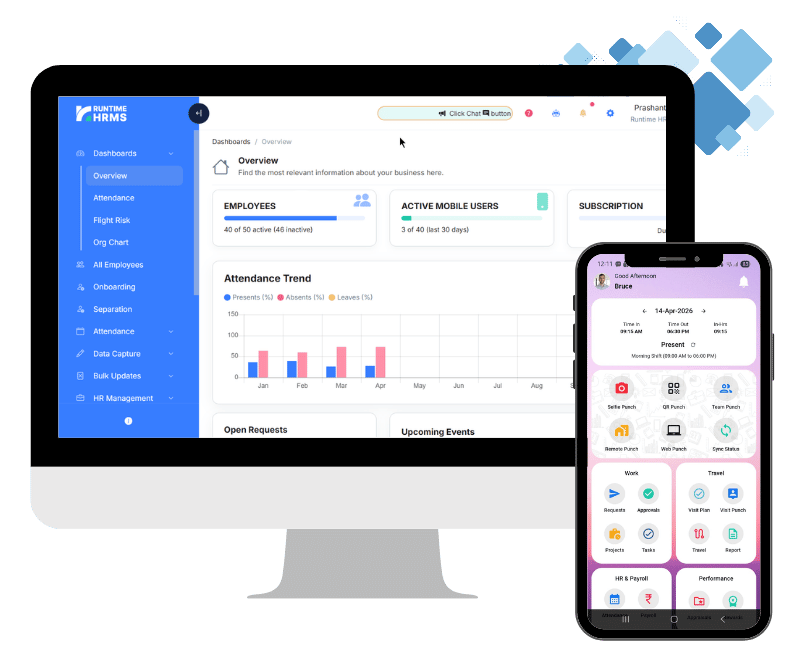
To work out the employee utilization rate, you need two clean sets of data: hours worked on each project, and the true available hours for each person. The second one depends on attendance, shifts, holidays and approved leave. If those records sit in different sheets, the rate is only as reliable as the weakest of them.
Want accurate hours behind your utilization numbers?
Runtime keeps attendance, shifts and leave in one place and feeds them into payroll, so your available hours match what was actually worked.
Sign Up TodayFAQs
What is the employee utilization rate formula?
Billable hours ÷ available hours × 100. Available hours are scheduled hours minus holidays and approved leave.
What is a good employee utilization rate?
For service firms, ranges of about 70% to 85% are commonly quoted. The right number depends on the role, the industry and how much non-billable work the job needs.
What does employee utilization rate mean?
It shows how much of a person’s available working time is spent on productive, usually billable, work.
What is the difference between billable and total utilization?
Billable utilization counts only invoiceable hours. Total utilization also counts non-billable productive work, such as training and internal projects.