

Quick Answer
Travel allowance for employees is the money a company pays for work travel: the fare or fuel, a daily allowance, stay and other trip costs. The cost of one trip is: (days × daily allowance) + (nights × stay) + travel cost + other costs.
Example: a 3-day trip with 2 nights, a daily allowance of ₹500, stay of ₹1,500 a night, 300 km at ₹3.47 per km and ₹200 of other costs comes to ₹5,741. The amounts are your own policy, and the kilometres need a record you can check.
Travel allowance for employees: a bill that grows quietly
If your team travels for work, travel allowance for employees is probably one of the larger lines on your monthly payroll, and one of the harder ones to predict. A single trip is a small number. Two trips a month for five people, every month, is a figure worth looking at.
The pattern is a familiar one. The policy lives in someone’s head, the claim is a form with a total at the bottom, and nobody can say quickly what travel costs in a year. Nothing is wrong with the people. The business simply never wrote the numbers down.
In this post I will explain what travel allowance for employees covers, how to set a daily allowance and a stay limit, and where claims go wrong. In the middle there is a free calculator that works out one trip, one month and one year.
What is travel allowance for employees?
In India the term is used in two different ways, and mixing them up causes confusion.
- A fixed travel allowance in the salary. A set amount paid every month as part of the pay structure, often called a conveyance or transport allowance. It does not change with the travel the employee actually does. How it sits in a salary structure is covered in Salary Structure Under the New Labour Code.
- Travel allowance for a work trip. Money paid for a particular journey: a client visit in another city, a site inspection, a training trip. It follows the trip and changes with it.
This post is about the second meaning. If your staff use their own vehicle for local visits, the fuel part of the cost is covered in Fuel Reimbursement for Employees.
What travel allowance for employees usually covers
| Part of the claim | What it is | How companies commonly set it |
|---|---|---|
| Travel | The journey itself: bus, train, flight, or own vehicle. | Actual fare against a ticket, or kilometres × a rate per km for own vehicle. |
| Daily allowance (DA) | A fixed amount for each day away, for food and small local costs. | A flat amount per day, often varied by city or grade. |
| Stay | The hotel or guest house for nights away. | Actual bill up to a cap per night, or a fixed amount. |
| Other costs | Toll, parking, local taxi, auto. | Actuals against a receipt, or a small fixed amount. |
None of these amounts is fixed by a single rule for every business. They are policy decisions, which is why writing them down matters.
Travel allowance calculator: one trip, one month, one year
Use the calculator below to see what travel allowance for employees costs. Choose how the employee travels, enter your own amounts, and add how many trips and how many people if you want the monthly and yearly figure. The “Copy claim summary” button gives you a clean summary to paste into an email or a claim form.
Free calculator
Travel Allowance Calculator
Work out what one work trip costs you, and what your travel allowance bill comes to each month and each year.
How does the employee travel?
What to do with the result:
- Look at the yearly figure first. A trip that feels small can add up to a large number across a team.
- Check which part is biggest. For many teams it is stay or fare, not the daily allowance.
- Compare with last year's claims. If the calculator is far below what you actually paid, find out where the difference comes from.
How to set a daily allowance and stay limit
There is no single correct daily allowance, and no one rule for travel allowance for employees that fits every business. A simple way to set one:
- Start from what a day away really costs in the cities your staff visit: meals and local travel, not the hotel.
- Decide whether one amount fits everyone. Many companies use a higher amount for metros or for senior roles.
- Set a stay cap per night, and decide whether staff may pay more and bear the difference.
- Decide how a part day counts, such as a trip that starts at noon or ends in the morning.
- Write it down and review it once a year, or when your costs change.
Why travel allowance for employees goes wrong
None of these is anyone's fault. They are what happens when the policy and the records are loose.
- No written limit. Each manager decides, so two people on the same trip get different amounts.
- The distance is a figure on a form. For own-vehicle trips nobody can say whether 300 km is right.
- Claims arrive weeks later. Receipts get lost and amounts are estimated from memory.
- Advances are never cleared. Money given before the trip stays open for months.
- Payroll is a separate step. Someone adds the approved total by hand, which takes time and invites errors.
How Runtime handles travel allowance for employees
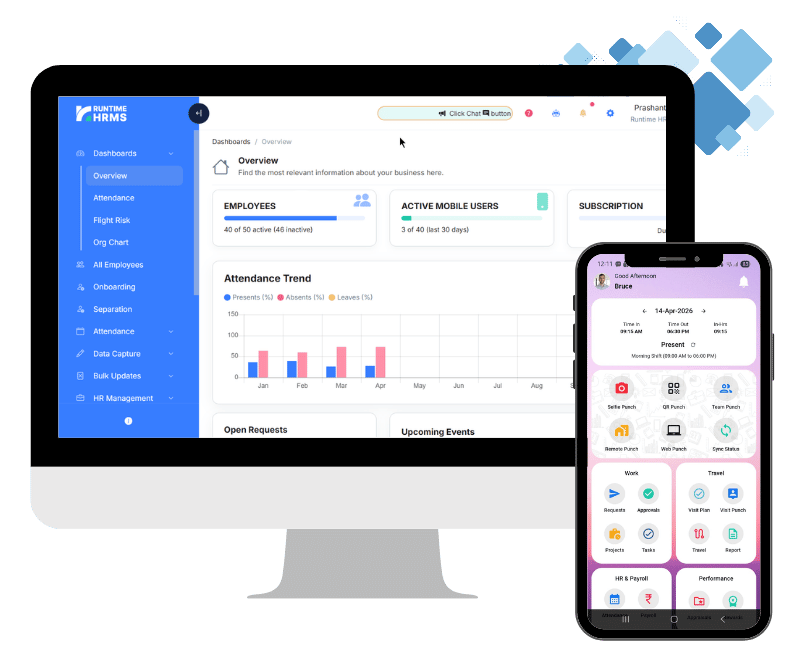
The part of travel allowance for employees that is hardest to check is distance on own-vehicle trips and visits. That is what Runtime Travel Tracking records. It works through the Runtime Workman app on the employee's phone and connects to payroll. Fuel and travel are handled in the same way.
| The problem | What Runtime does |
|---|---|
| The distance is only a number on a form | Live Travel shows the route map and distance travelled when the trip is completed, and you can view the route taken. |
| No proof of the client visit | Travel Punch records client visits with client details, and the location and address are picked up from the phone's GPS (geo-tagging). |
| Was the employee actually at the client's place or the site? | Geo-tagging records where each punch is made. Geo-fencing lets you mark a site or client location, so a punch can be checked against it. |
| Working out the amount by hand | An in-built conveyance reimbursement calculation multiplies the kilometres travelled by the rate per km you have set. |
| Entering the amount into payroll again | Travel data is linked to payroll for reimbursements. |
| No network on the road | Visit data saved offline syncs to the server when the phone is back online. |
Because the distance comes from the phone, the same record supports fuel reimbursement and the own-vehicle part of a trip claim.
Want to see how the route and distance of a trip are recorded for your field team? Have a look at Runtime Travel Tracking.
See Runtime Travel TrackingWhat to put in a travel allowance policy
A short written policy for travel allowance for employees removes most arguments. Cover these points:
- Who is eligible, by role or grade.
- What is covered: travel, daily allowance, stay and other costs.
- The amounts: daily allowance, stay cap, and the rate per km for own vehicle, by city or grade if you vary them.
- Mode of travel: which class of train or flight is allowed, and when a cab is fine.
- Advances: whether you pay one, and by when it must be cleared.
- Proof: tickets, bills and the distance record.
- Approval and deadline: who approves, and how many days after the trip the claim is due.
- What is recorded: if you track location, tell employees what is recorded, when and why, in the policy.
Settle travel claims with the distance on record
Runtime records each trip from the employee's phone, applies your rate per km and links the amount to payroll, so every travel claim has a distance behind it.
Sign Up TodayRead Our Oher Useful Resources
DPDP Act for HR
Understand your responsibilities for protecting employee records and personal data, including location data.
7 Things to Check Before Running Payroll
Run through the monthly checks that catch errors before salaries and travel claims go out.
Full and Final Settlement Calculator
Calculate employee exit dues, including any travel claims still open when someone leaves.
EPF Wage Ceiling Guide
Review PF coverage and payroll implications as allowances and your team grow.
Also check the latest update on rules: Income Tax India