
Quick Answer
A leave policy for small business is a short written set of rules: working days and hours, late marks, how many leaves of each type, how to apply, what happens to unused leave, and how overtime and comp-off work. Written once and shared with everyone, it stops the same questions coming back every month.
Use the free policy builder below to draft yours in about two minutes. Then have it checked against your state’s rules before you issue it.
Why a leave policy for small business matters?
A leave policy for small business sounds like paperwork. In practice it is what stops the same argument from happening every month. “Is Saturday a working day?” “Does coming in 20 minutes late count as a half day?” “Who approved this leave?” Without a written rule, each answer depends on who you ask, and employees notice.
This guide explains why a leave policy for small business matters, who needs one and what it should cover. It then gives you a free builder to draft your own.
At Runtime HRMS, I see the same pattern shows up again and again in small companies. Policies are rarely missing because the owner does not care. They are missing because everyone knows the rules in their head, until the team grows. This is why a written policy helps:
- It ends the arguments. When the rule is in writing, nobody has to remember what was said last year.
- It makes everyone equal. The same late-mark rule applies to the new joiner and the senior manager.
- It keeps payroll right. Leave and attendance feed straight into salary. If the rules are unclear, the salary is where the confusion lands.
- It covers the legal basics. Working hours, overtime and some leave are set by law, and your policy shows you follow them.
- It makes exits cleaner. A leave balance is part of the full and final settlement. A clear policy tells you what the balance is and what happens to it.
Who needs a leave policy for small business teams?
Every business with employees benefits, but these situations make it urgent:
- You are growing past 10 or 20 employees. More people means more exceptions, and legal thresholds start to apply. See what to do after hiring 20 employees
- You have shifts, field staff or remote employees. “Working hours” means something different for each group.
- You have just hired your first HR person. A policy gives them a standard to work from, not a blank page.
- Payroll still runs on Excel. Every leave and late mark is counted by hand, and every disagreement is settled by memory.
- You are opening a second location, where the rules may differ by state.
What a good leave policy for small business covers
A small business does not need a 30-page manual. Two pages that cover these nine things are enough:
- Purpose and scope: who the policy applies to.
- Working days and hours: the working week, weekly off and daily hours.
- Attendance: how it is marked, grace time, late marks and half days.
- Leave entitlements: casual, sick, earned, maternity and public holidays.
- Applying for leave: notice period and who approves.
- Unused leave: lapse, carry forward or encashment. See leave encashment rules.
- Overtime and comp-off: when it is allowed and how it is paid.
- Records and misuse: what happens with false entries.
- Changes: how updates are communicated.
What the law decides and what you decide
Some things are fixed by law. Others are your choice. Knowing which is which keeps your policy sensible.
| Topic | What is generally fixed or left to you |
|---|---|
| Working hours | Generally capped at 8 hours a day and 48 hours a week, with no more than 6 working days a week and a break after 5 hours of continuous work. |
| Overtime | Work beyond the limits is paid at twice the ordinary rate, needs the worker’s consent, and has a quarterly cap. |
| Earned leave | Earned after 180 days worked in a year, at about 1 day for every 20 days worked. Carry forward is reported to be capped at 30 days, with the excess encashed. Sources differ on details. |
| Maternity leave | Set by law (26 weeks of paid leave is cited for eligible women). Check eligibility rules. |
| Final settlement | Wages due within two working days of leaving, including encashable leave. |
| Casual and sick leave | Not fixed by the central codes for private offices. Your state’s Shops and Establishments rules or your own policy decide. |
| Yours to decide | Grace time, late-mark rules, half-day rules, leave notice, comp-off, how attendance is marked for field staff, and anything more generous than the law. |
Two cautions. The central rules mainly cover establishments with 10 or more workers, and state rules still apply to many shops and offices. Where two rules apply, follow the stricter one. And a policy can be more generous than the law, but never less.
Build your leave policy for small business in 2 minutes
Answer 12 short questions about how your business works. The builder writes a draft policy you can copy, edit and have reviewed. It deducts leave, not pay, for late marks, and it uses “as per the applicable law” wherever the law sets the rule, so you do not hard-code a number that may change.
Free policy builder: your leave and attendance policy in 2 minutes
What to do with your leave policy for small business draft
- Edit it. Change anything that does not match how you really work. A policy nobody follows is worse than none.
- Get it reviewed. Ask your CA or a labour-law adviser to check it against your state’s rules and your type of establishment.
- Share and record it. Give it to every employee and keep an acknowledgement, signed or recorded.
How Runtime applies your leave policy for small business in one place
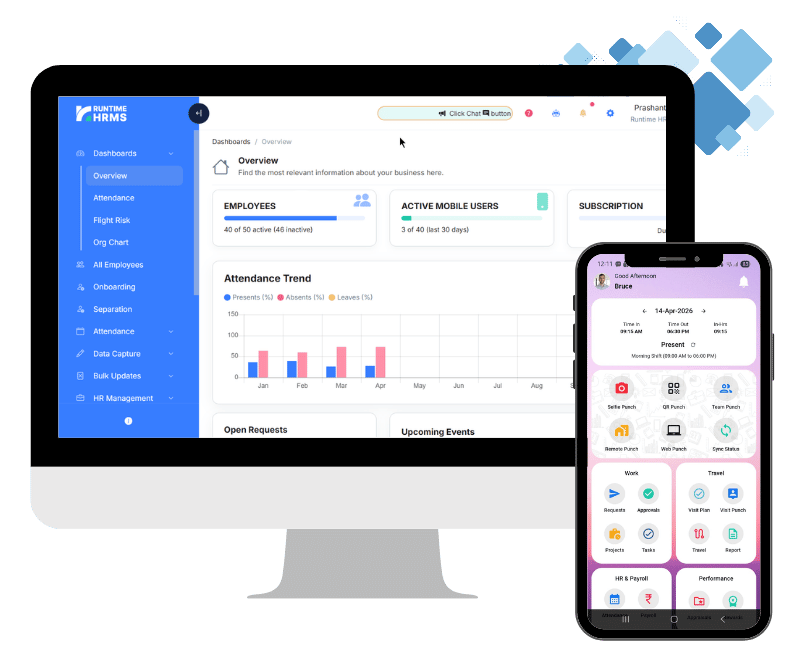
Writing the policy is half the job. The other half is applying it every month: the right leave balance, the right late-mark count, the right salary. That is where a document in a folder usually falls behind.
Runtime already has policy formats ready, so HR can start from a format instead of a blank page and make it their own.
Once the policy is decided, the same rules run in the system:
| Your policy says | In Runtime |
|---|---|
| Working days, shifts and weekly off | Shift rostering and rotations in Time and Attendance. |
| Grace time and late marks | Attendance rules for grace and late marks. |
| Casual, sick and earned leave | Leave policies set up to match your workflow, with balances. |
| Applying for leave and approvals | Employees submit leave requests from Runtime Workman. Approval flow |
| Field and remote attendance | Geo-tagged and geo-fenced mobile attendance. |
| Overtime | Automatic overtime calculation from attendance. |
| Salary, PF, ESI and TDS | Calculated from attendance and leave data in Runtime Payroll. |
| Letters, such as warning or confirmation | Pre-defined HR letter templates, one click to send. |
For a small business, the difference is simple. Rules decided once are applied the same way for every employee and every month, and HR is not counting late marks by hand at month end. Because attendance, leave and payroll sit in one HRMS, the leave balance and the salary come from the same record.
A policy on paper is easy. Applying it every month is the hard part.
See how Runtime keeps leave, attendance and payroll in one system, so your policy runs the same way for every employee.
Sign Up TodayCommon mistakes in a leave policy for small business
- Copying a big company’s policy. It will contain rules you cannot follow. Start from your own working week.
- Promising more than you can track. A rule you cannot apply consistently creates more disputes than it solves.
- Leaving late marks vague. “Frequent lateness” means different things to different managers. Put a number on it.
- Deducting pay for lateness without checking. Wage deductions are regulated. Deducting leave is usually safer, but ask your adviser.
- Never sharing it. A policy employees have not seen is not a policy.
- Forgetting field and remote staff. Say how their attendance is marked and checked.
FAQs
What is a leave policy for small business?
It is a short written document that says how many leaves each employee gets, how to apply, what happens to unused leave and how attendance, late marks and overtime are handled.
Is a leave policy mandatory for a small business?
The law sets some leave and working-hour rules, and state rules apply to many shops and offices. A written policy is how you show and apply them. Ask your adviser what applies to you.
How many casual and sick leaves should a small business give?
There is no single central number for private offices. State Shops and Establishments rules or your own policy decide. Many small businesses choose between 6 and 12 days of each.
How much earned leave does an employee get?
As commonly reported, earned leave is earned after 180 days worked in a year, at about 1 day for every 20 days worked. Check the rule for your establishment and state.
Can I deduct salary for late marks?
Deductions from wages are regulated, so do not assume you can. Many employers deduct leave instead. Ask your adviser before you deduct pay.
What is comp-off?
A compensatory off is a day off given in return for work on a weekly off or a holiday. Your policy should say how long the employee has to take it.
Check our other useful resources
Leave Policy for Small Business in India
Set one clear leave and attendance policy, so available hours are counted the same way every month.
Leave Encashment in India
Understand how unused leave is paid out, so leave balances don’t surprise you at month end.
Payroll Software for CAs
See how CA firms keep attendance, leave and payroll in one place as the team grows.
Applicant Tracking System for Small Business
Check whether your hiring has outgrown spreadsheets before an overloaded team starts making mistakes.
Also check: New labour codes: how you earn, carry and encash leave (Outlook Money)