
Quick Answer
Why employees leave is rarely one big reason. In a small business it is usually a handful of fixable things: pay that is late or hard to understand, no visible growth, rules that feel unfair, no feedback, a difficult manager, overload without recognition, and a weak first month.
Look at your last five exits, sort each into these seven reasons, and fix the most common one first. Most of them are systems you control, not luck.
The question every owner asks after a resignation
You trained someone for six months. They knew your customers, your suppliers and your way of working. Then one Monday morning there is a resignation letter, and the question in your head is the same one most owners ask: why do people keep leaving?
It feels personal, and it is easy to decide that people today are not loyal. But when you look at why employees leave across a small business, the reasons repeat. They are mostly about how the business runs day to day. Understanding why employees leave is the first step, because the good news is that you can see the reasons, and you can change them. This post lists seven of them, with what to check and what to do about each.
What one resignation really costs
Before the reasons, a number worth knowing, because it shows why employees leave is a money question and not only a people question. When someone leaves, you pay for the gap, not just for the replacement.
- Hiring time and effort: advertising, screening, interviews.
- Lost output: the work that waits or gets done badly while the seat is empty.
- Training: weeks or months before the new person works at the old person’s pace.
- Team strain: colleagues carry extra work, and that is often what triggers the next resignation.
A simple way to size it is to take the monthly salary of the role and multiply it by the number of months it takes a new hire to reach full output. As an illustration only, if a ₹30,000 role takes about three months to settle, that is roughly ₹90,000 of reduced output and effort for one resignation, before hiring costs. To see what an employee costs you in total each month, use the Payroll Cost Calculator.
7 reasons why employees leave, and what to do about each
1. Pay is late, wrong or hard to understand
People forgive a modest salary more easily than an unpredictable one. A salary that arrives on a different date every month, a deduction nobody can explain, or a payslip that does not match the amount in the bank all quietly damage trust.
- Check: in the last six months, how many salaries went out late, and how many employee queries came in about deductions or amounts?
- Fix: pay on a fixed date, show every earning and deduction on its own line, and give each employee a payslip with the salary. A payslip they can understand is one of the cheapest retention tools you have. If you want a quick way to make one, see our salary slip generator
2. No visible growth
If a good employee cannot see what the next step looks like, they will look for it elsewhere. In a small business there may not be many titles, but there can still be a path: more responsibility, a new skill, a pay review date.
- Check: can each person in your team say what they could be doing in a year, and what it would take?
- Fix: agree one growth goal per person, set a date for a pay review, and write down what has to happen before it. Even a short, honest “this is what is possible here” helps.
3. Rules that feel unfair or are applied differently
Attendance, leave approvals, overtime and flexibility cause more quiet resentment than many owners realise. When two people in the same situation get different answers, the team notices quickly. A manager who says yes to one request and no to the same request from someone else damages trust in the whole system.
- Check: do you have a written leave and attendance policy, and are approvals recorded the same way for everyone?
- Fix: write the rules down and apply them evenly. The Leave Policy for Small Business post covers how to do this without making it heavy.
4. No feedback, so nobody knows how they are doing
Many resignations come from people who never heard whether they were doing well. A good employee who gets silence for a year starts to wonder whether the work is noticed.
- Check: when did you last tell each person, in specific terms, what is going well and what to improve?
- Fix: hold a short one-to-one every month or every quarter, with the same three questions each time: what went well, what was hard, what do you need from me.
5. The immediate manager
People often say they left the company, but they left their manager. In a small business, the “manager” may be you, a partner or a senior colleague who was promoted for skill, not for managing people.
- Check: which managers have lost the most people, and what do the exits have in common?
- Fix: give people-managers a small amount of guidance on the basics: clear tasks, fair treatment, regular feedback. Promoting someone who is excellent at the work does not make them good at leading others, so help them learn it.
6. Overload without recognition
When the team is short, the people who say yes get more work. If that extra work is never acknowledged, not paid for and not planned, the most reliable people burn out first, and they are the ones you cannot afford to lose.
- Check: who has regularly worked beyond hours, and what did they get for it?
- Fix: record overtime, pay it as per your policy and the law, and say thank you in a way that is specific. See the Employee Utilization Rate post for how to see who is stretched and who has room.
7. A weak first month
Early exits often trace back to the first weeks: no desk or login ready, no clear first task, no introduction to the team, and no one to ask. The employee decides quickly whether this place is organised.
- Check: for your last three joiners, was everything ready on day one, and did they know who to ask for help?
- Fix: use a short joining checklist: documents, access, a buddy, a first-week plan, and a check-in at 30 days. If you want to see how Runtime handles joining, look at the
How to find why employees leave in your own business, in 30 minutes
You do not need a survey to start. Take your last five exits and fill in this table from memory and from your records.
| Question | Where to look |
|---|---|
| How long did they stay? | Joining and exit dates. Many exits within three months point to reason 7. |
| Was there a pay or leave dispute before they left? | Salary queries, leave rejections and overtime records. This points to reasons 1, 3 and 6. |
| Who did they report to? | Group the exits by manager. A cluster points to reason 5. |
| Did they get a raise or a new role in the last year? | Pay and role history. No change points to reason 2. |
| What did they say on the way out? | Exit conversation notes. People are often more honest in the last week than they were all year. |
Count which reason shows up most. That is the one to fix first, and it is the most honest answer you will get to why employees leave your business.
Ask the ones who stayed: five stay-interview questions
Exit interviews tell you why employees leave after the decision is made. Stay interviews tell you what keeps people, and what might push them out next. Ask each person you want to keep:
- What makes you look forward to work?
- What makes you dread it?
- What would make you think about leaving?
- What do you want to be doing in a year?
- What is one thing I could change that would help you most?
Listen, do not argue, and act on at least one thing you hear.
A simple 30-day plan
- Week 1: fill the five-exit table and pick the top reason.
- Week 2: fix the pay-date and payslip basics, and write down the leave and attendance rules if they are not written.
- Week 3: hold the first five stay interviews with your most valuable people.
- Week 4: put a pay review date and one growth goal on paper for each of them, and set a monthly one-to-one.
How Runtime helps with the systems behind why employees leave
Most of the seven reasons come down to whether basic processes run on time and in the open. These are the places where a system helps. Runtime does not fix a culture, but it removes avoidable friction.
| The pressure point | What Runtime does |
|---|---|
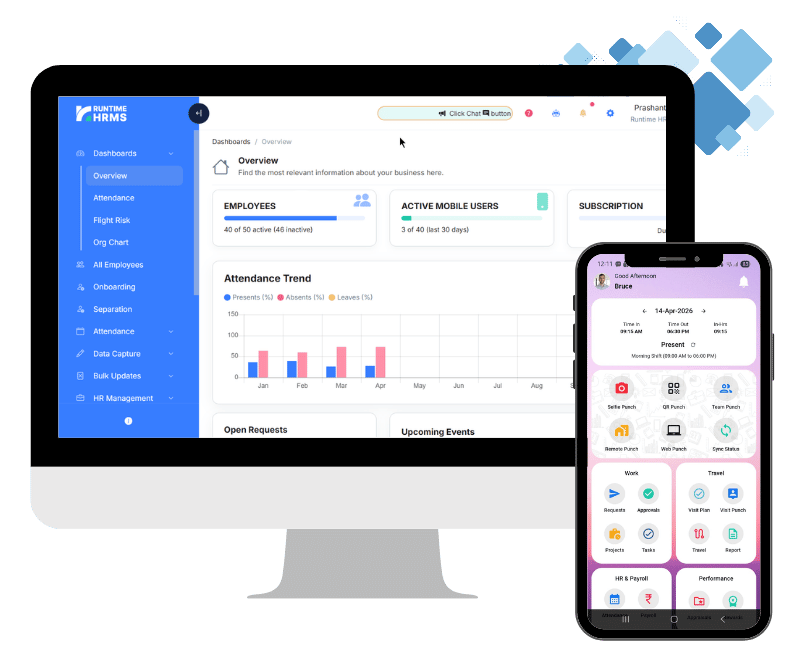
| Late or wrong salary, unclear payslips | Payroll runs on attendance and leave, with PF, ESI, professional tax and TDS worked out in the same place. Payslips go out in one click from the HR portal. |
| “I can’t see my payslip or leave balance” | Employees use the Workman app to download payslips, apply for leave and file reimbursement claims. |
| Attendance disputes and unrecorded extra hours | Mobile, QR, web and biometric punch, with geo-tagging and geo-fencing, and overtime calculated automatically from attendance records. |
| Loans and advances that cause confusion | EMI is deducted automatically from salary, so the balance is clear. |
If salary dates, payslips and leave approvals are the things your team complains about, have a look at how Runtime handles them in one place.
See the Workman appMistakes owners make when people keep leaving
- Blaming the market or the generation. It ends the search for why employees leave too early.
- Offering a raise as the only answer. If the reason was feedback or fairness, money buys a few months at best.
- Skipping the exit conversation. Many exits are the only honest feedback you get.
- Fixing it all at once. Pick the most common reason and fix that first.
- Counter-offers as a habit. If people resign to get a raise, you have a pay review problem, not a retention plan.
FAQs
Why do employees leave small businesses?
Usually for a mix of fixable reasons: late or unclear pay, no visible growth, unfair rules, no feedback, a difficult manager, overload without recognition, and a poor first month.
What is the most common reason why employees leave?
It varies by business. The way to find out is to sort your last five exits into the seven reasons above and see which repeats.
How can I reduce employee turnover in a small business?
Start by finding why employees leave your business, then fix the most common reason in your exits first. Pay on a fixed date, keep rules written and fair, give regular feedback and agree a growth goal for each key person.
Is salary the main reason why employees leave?
Pay matters, but late or unclear pay often does more harm than a modest salary. Growth, fairness and feedback matter too.
Remove the friction your team complains about
On-time payslips, clear leave and attendance, and automatic overtime, all in one system. See how Runtime runs it for a team like yours.
Sign Up TodayOther useful resources
What to Do After Hiring 20 Employees
Put the right systems in place as your team grows, before the gaps cost you people.
Salary Structure Under the New Labour Code
Understand how pay is split so payslips are clear and fair.
7 Things to Check Before Running Payroll
Avoid the payroll errors that make employees lose trust.
Full and Final Settlement Calculator
When someone does leave, settle their dues correctly and on time.